1. Taj Lake Palace, Udaipur
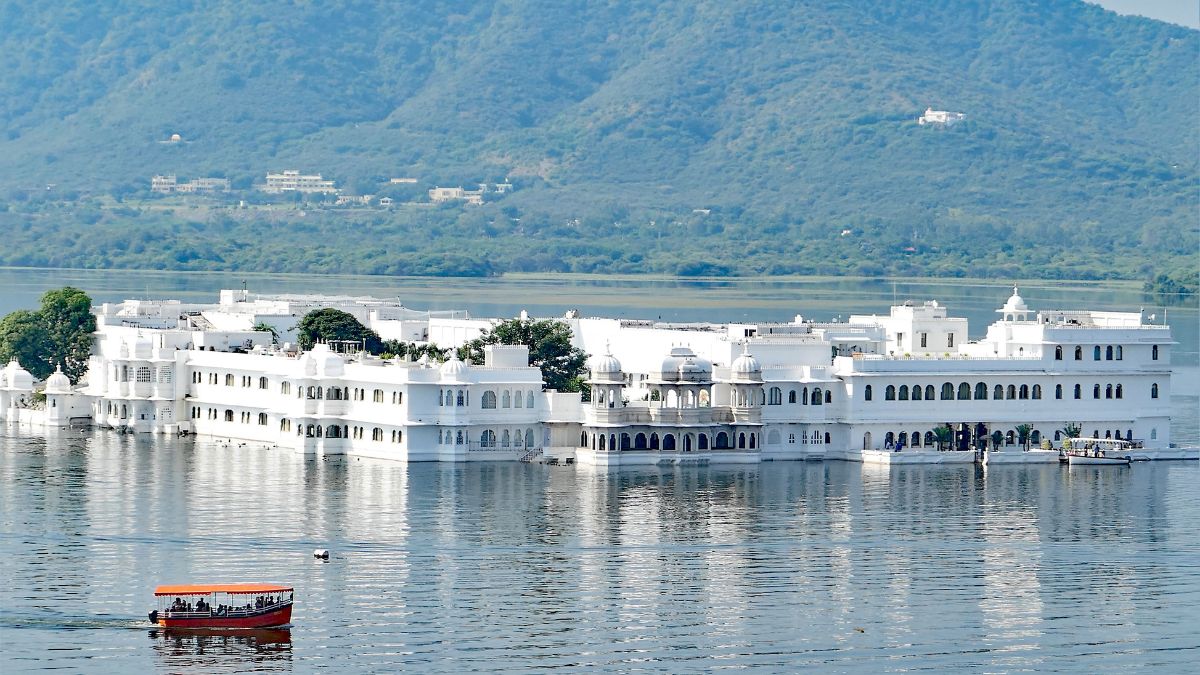
Rising from the waters of Lake Pichola as if carved from the lake itself, Taj Lake Palace is widely regarded as the most romantic Taj property in India. Originally commissioned in 1743 by Maharana Jagat Singh II as a royal summer retreat named Jag Niwas, the palace occupies a four-acre natural island of white marble, accessible only by private boat from the City Palace jetty. The architecture is pure Mewar Rajput: cusped arches, delicate jharokha balconies, open courtyards, and semi-precious stone inlay work, all oriented eastward so the Maharana could greet the sunrise in prayer.
International audiences may recognise the palace from its appearance in the 1983 James Bond film Octopussy, but its real allure is far quieter — a place where every window frames the Aravalli Hills and the shimmering lake-and-palace skyline that defines Udaipur. This is the Taj property most recommended for honeymooners and couples seeking an unmistakably Indian setting for a once-in-a-lifetime stay.
2. Rambagh Palace, Jaipur
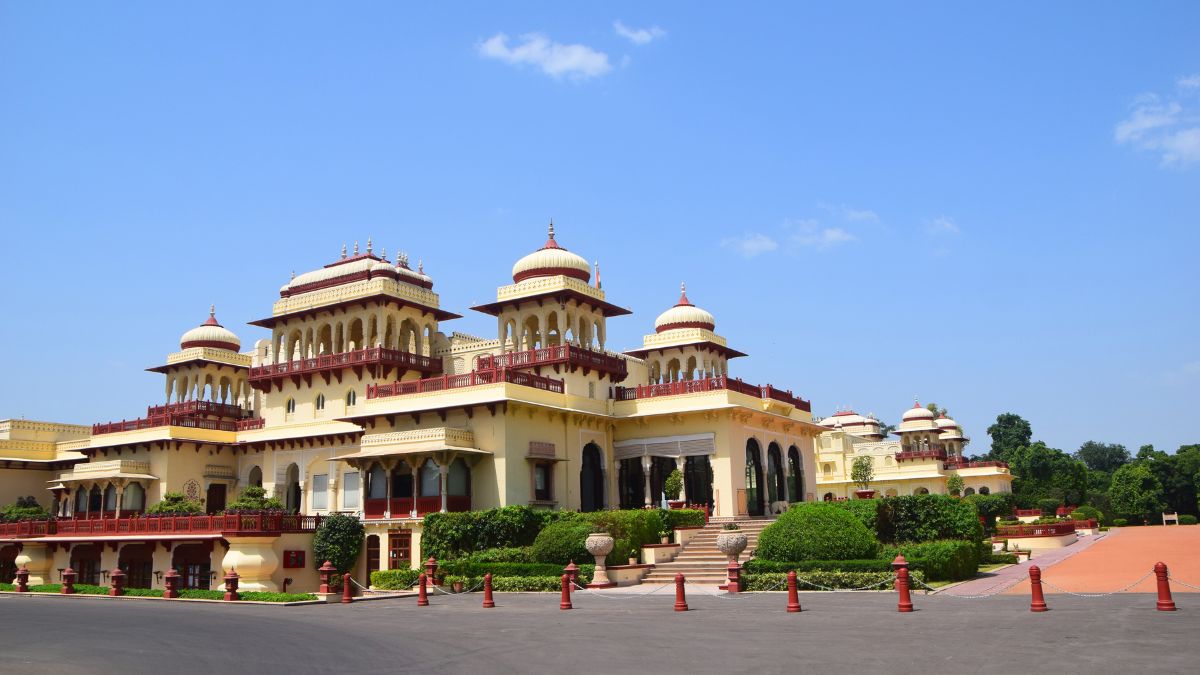
If one property captures the full arc of Rajput royal life, it is Rambagh Palace. Built in 1835 as a modest garden house for a prince’s nurse, it was expanded by the British architect Sir Samuel Swinton Jacob into a grand residence, and in 1931 became the principal home of Maharaja Sawai Man Singh II and his celebrated wife, Maharani Gayatri Devi. The palace sprawls across 47 acres of manicured gardens in the heart of Jaipur, and its interiors still carry the imprint of its royal residents — from the Suvarna Mahal, a former banqueting hall lit by Florentine crystal chandeliers, to the Polo Bar, lined with the Jaipur royal family’s polo trophies.
Managed by Taj Hotels since 1972, Rambagh remains the definitive palace hotel in Rajasthan. Heritage lovers, first-time India visitors, and travellers drawn to the Pink City’s Rajput history can experience the lifestyle of Indian royalty — not as theatre, but as daily atmosphere across a living estate. The palace also fits naturally into a luxury Golden Triangle tour, where Jaipur is combined with Delhi and Agra.
3. Taj Falaknuma Palace, Hyderabad
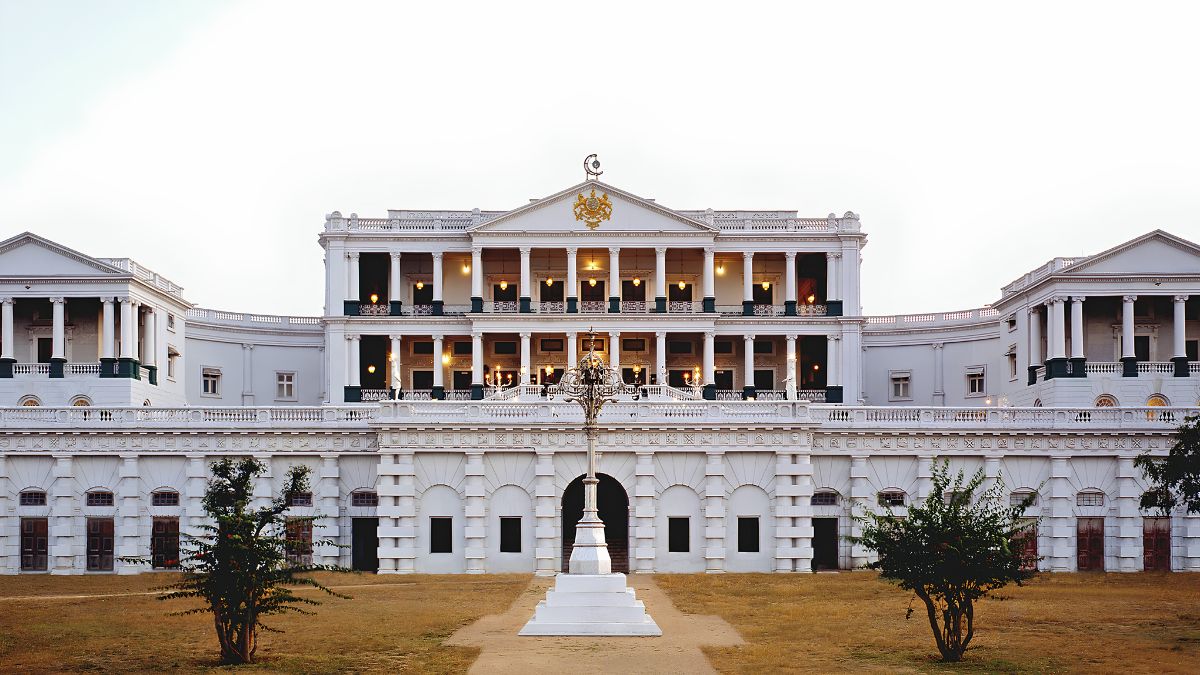
Perched on the Koh-i-Tur hill roughly 2,000 feet above Hyderabad, Falaknuma Palace — the name translates to “Mirror of the Sky” — offers the most dramatic arrival of any Taj property. Built between 1884 and 1893 by Nawab Sir Viqar-ul-Umra, head of the noble Paigah family, it was designed by English architect William Ward Marrett in an Italian Renaissance and Tudor style rare for the Deccan. Its layout follows the physical form of a scorpion — the Nawab’s zodiac sign — and its interiors house extraordinary collections: a library modelled after Windsor Castle with over 5,900 rare volumes, Venetian chandeliers, and a 101-seat rosewood dining table famed for its acoustic properties.
After decades of dormancy, Princess Esra of the Nizam’s family led a meticulous ten-year restoration with IHCL, and the palace reopened as a hotel in 2010. Guests ascend the hill by horse-drawn carriage and are received at a grand marble staircase — a ritual echoing the reception once given to visiting royalty, including King George V. For travellers interested in the courtly Nizam heritage of Hyderabad, a cultural world entirely distinct from Rajasthan, Falaknuma is without equal.
4. Umaid Bhawan Palace, Jodhpur
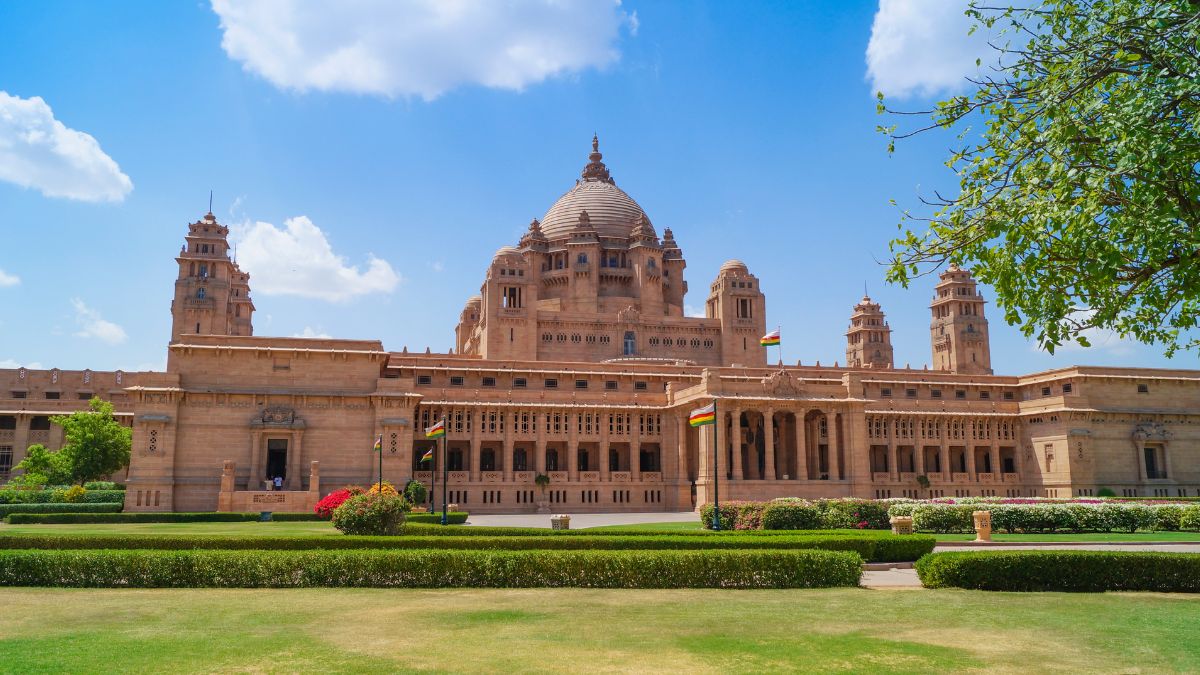
Umaid Bhawan Palace holds a distinction no other Taj property can claim: it is the last grand palace built in India before Independence, and part of it remains a private royal residence today. Commissioned in 1929 by Maharaja Umaid Singh of the Rathore dynasty, the palace was conceived as both an architectural statement and a famine-relief project, employing over 3,000 local workers during severe Marwar droughts. Completed in 1943 and designed by Henry Vaughan Lanchester, it blends Art Deco interiors — including murals by the Polish artist Stefan Norblin and a subterranean Zodiac swimming pool — with traditional Rajput chhatris and a soaring 105-foot dome. The golden-yellow Chittar sandstone was laid without mortar.
Today, the palace operates as three distinct spaces: the private residence of Maharaja Gaj Singh II, a Taj heritage hotel, and a museum displaying royal artefacts. Set atop Chittar Hill alongside views of the formidable Mehrangarh Fort, Umaid Bhawan suits travellers who want to experience Jodhpur’s Marwar heritage within a property that feels both palatial and inhabited — a rare quality in palace hotels anywhere.
5. The Taj Mahal Palace, Mumbai
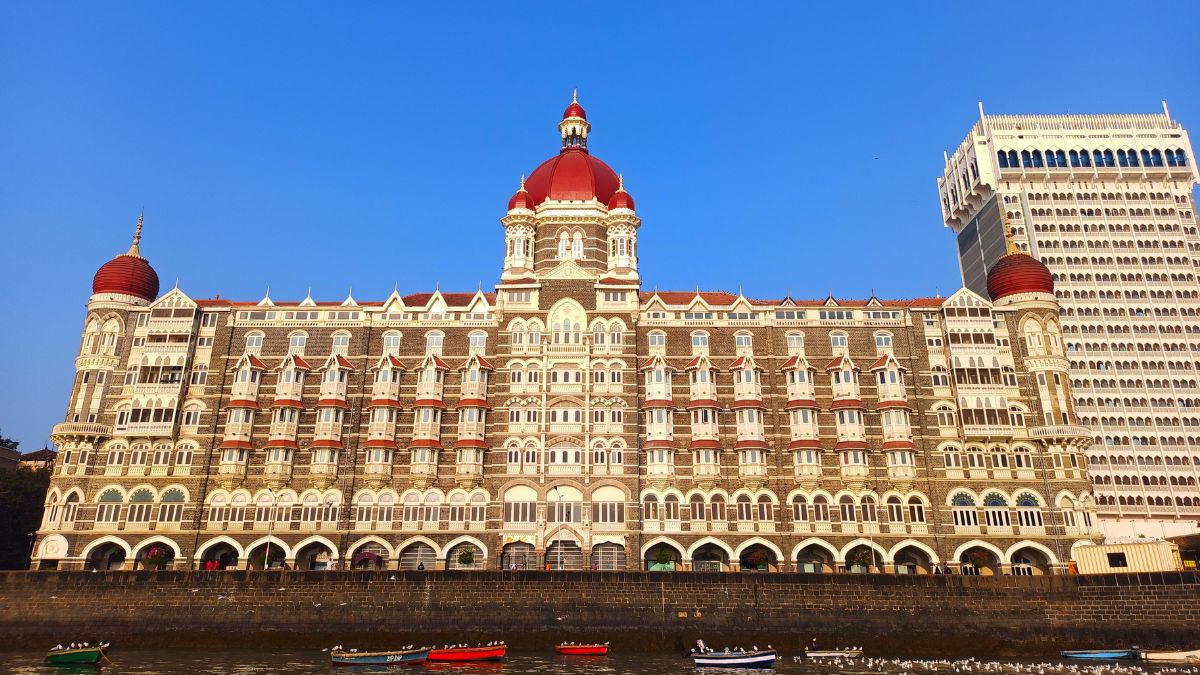
No list of Taj properties begins without this one. The Taj Mahal Palace in Mumbai is the flagship of the entire IHCL portfolio — the hotel that started everything. Opened on 16 December 1903 by Jamsetji Nusserwanji Tata, the visionary industrialist and Tata Group founder, it was built as Bombay’s first world-class hotel, equipped with electricity, German elevators, and Turkish baths at a time when few Indian buildings had any of them. Its red Florentine dome served as a navigational landmark for ships arriving in Bombay for two decades before the Gateway of India was built alongside it in 1924. The architecture — Indo-Saracenic and Victorian Gothic, conceived by Sitaram Khanderao Vaidya, D.N. Mirza, and W.A. Chambers — houses an art collection of over 4,000 works.
The hotel’s public spaces have witnessed more than a century of Indian history, from the freedom movement to Mumbai’s emergence as a global financial capital. For travellers arriving in the city, the Taj Mahal Palace is the most famous Taj hotel in India, and spending even a night here offers a perspective on Mumbai that no other property can replicate.
6. Taj Nadesar Palace, Varanasi
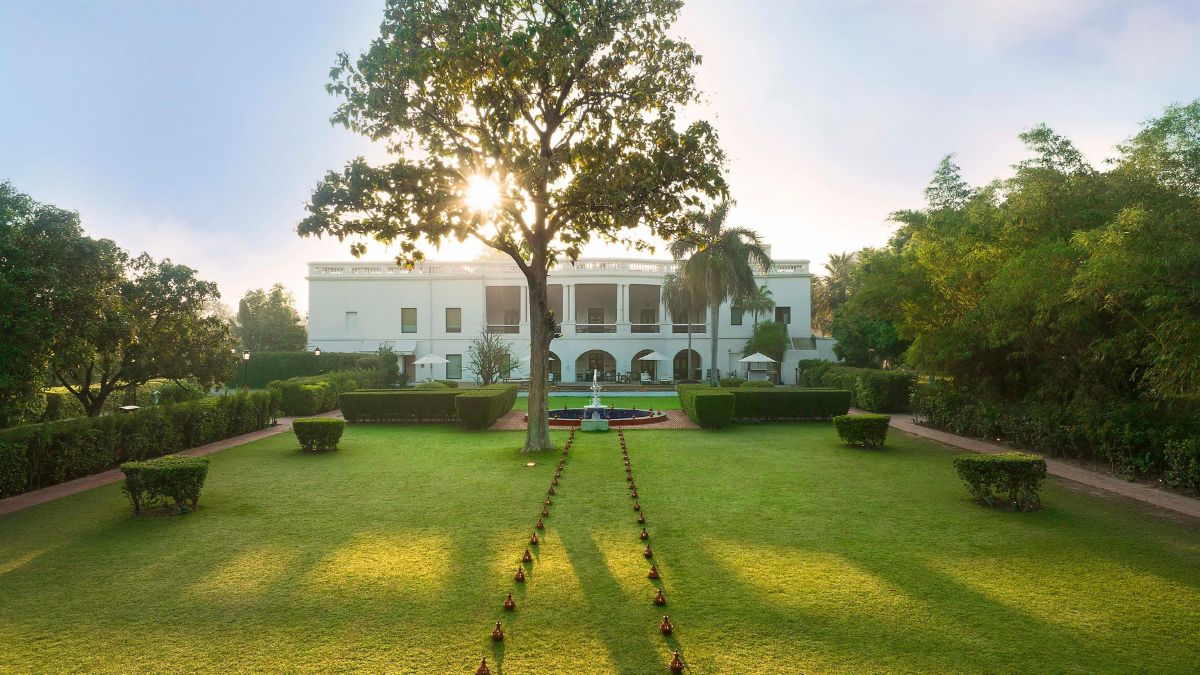
If Taj Lake Palace is the brand’s most romantic property, Taj Nadesar Palace is its most intimate. Hidden within 32 acres of private mango orchards, jasmine fields, and marigold gardens on the outskirts of Varanasi, this ten-suite palace hotel offers an experience of near-total seclusion — a remarkable contrast to the intensity of the holy city’s ghats along the Ganges. The estate was built in the late eighteenth century as a British Resident’s house before being acquired in 1889 by Maharaja Prabhu Narain Singh of the Royal House of Benares. Over the following decades it hosted King George V, Queen Elizabeth II, and the Dalai Lama.
Each of the ten suites is named after a former royal or viceregal guest. A 300-year-old Hindu temple on the grounds holds daily Vedic rituals, and guests are ferried across the estate by horse-drawn carriage. Nadesar is the Taj property best suited to cultural and spiritual travellers — those who want to experience Varanasi’s sacred heritage from a place of calm and privacy.
7. Taj Fateh Prakash Palace, Udaipur
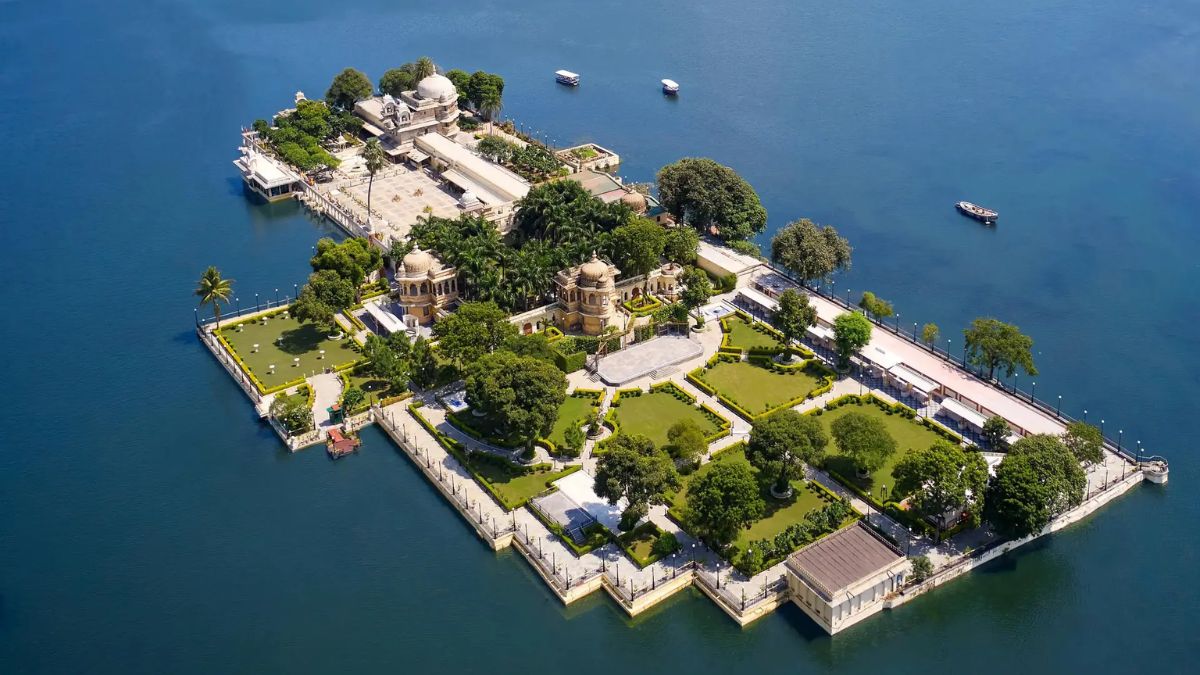
While Taj Lake Palace floats on the water, Taj Fateh Prakash Palace sits within the walls of the City Palace complex itself — making it the only Taj property that is physically part of a functioning royal fort-palace. Commissioned by Maharana Fateh Singh in the early twentieth century for state banquets and viceregal receptions, its centrepiece is the Durbar Hall, whose foundation stone was laid by Viceroy Lord Minto in 1909. The hall houses a 1,000-kilogram crystal chandelier and opens onto the Crystal Gallery, displaying the world’s largest private crystal collection — items ordered from F&C Osler of Birmingham in 1877 by Maharana Sajjan Singh, whose crates remained sealed for 110 years before being unveiled in 1994.
Guest rooms face directly onto Lake Pichola, with views stretching to the Lake Palace and Jag Mandir. For travellers visiting Udaipur who want to be embedded within Mewar’s living royal heritage rather than observing it from afar, Fateh Prakash Palace offers an experience that is both grander and more historically layered than a standalone hotel.
8. Jai Mahal Palace, Jaipur
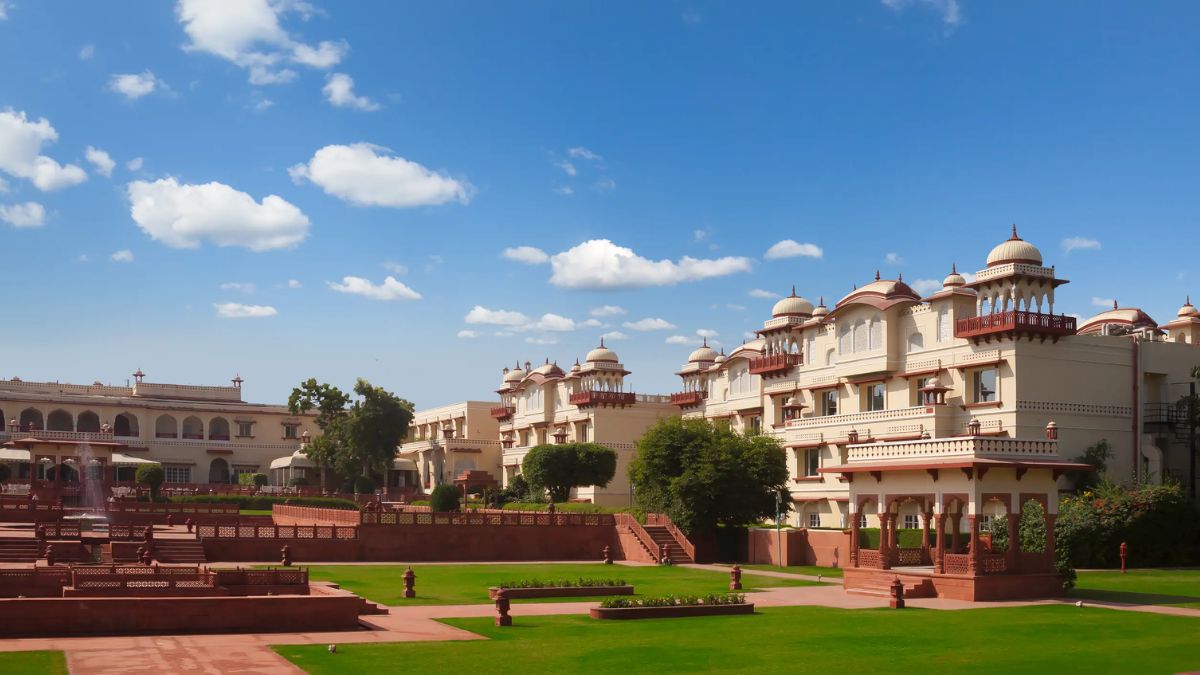
Where Rambagh Palace delivers the full spectacle of Jaipur’s royal court life, Jai Mahal Palace offers something different: 18 acres of formal Mughal-style Charbagh gardens — geometric waterways, stone lotus fountains, stepped pathways, and shaded pavilions — wrapped around a quieter, more contemplative Indo-Saracenic residence. Originally built in 1745 for Hargovind Natani, a military commander and prime minister to the ruler of Jaipur, the estate later served as the official home of successive Jaipur prime ministers and, in the late nineteenth century, of Dr Thomas Holbein Hendley, the British Residency Surgeon and noted scholar of Rajasthani art.
Taj Hotels opened it as a heritage hotel in 1986. For families, couples, and travellers who appreciate garden settings and a gentler pace within the Pink City, Jai Mahal provides a refined Rajput heritage stay without the scale and ceremony of Rambagh — a compelling alternative for those planning multiple nights in Jaipur.
9. Taj Usha Kiran Palace, Gwalior
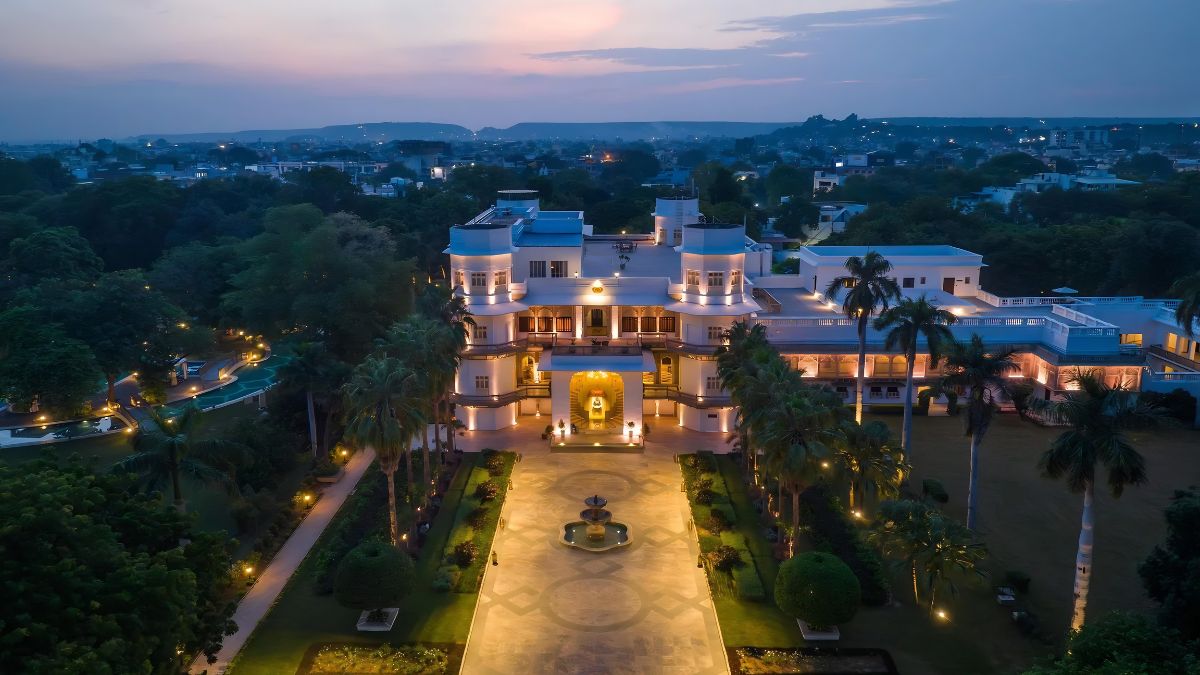
Gwalior rarely features on first-time India itineraries, which is precisely why the travellers who do visit tend to be the most rewarded. Taj Usha Kiran Palace sits on a nine-acre estate in Lashkar, adjacent to the imposing Jai Vilas Palace and within sight of the eighth-century Gwalior Fort — a citadel once described as “the pearl in the necklace of the forts of Hind.” Built by the Scindia Maratha dynasty as a royal guesthouse, the palace hosted the Prince and Princess of Wales during their 1902 visit and later Edward, Prince of Wales, in 1921.
Its Indo-Gothic and Maratha architecture retains original details: a functioning 1930s rosewood elevator with open wire-mesh grillwork, vintage ceiling fans, and Maratha court stone carvings. For heritage enthusiasts and repeat India visitors seeking destinations beyond Rajasthan, Usha Kiran Palace offers an introduction to Central India’s Maratha royal legacy that few travellers — and fewer luxury hotels — provide.
10. Taj Exotica Resort & Spa, Goa
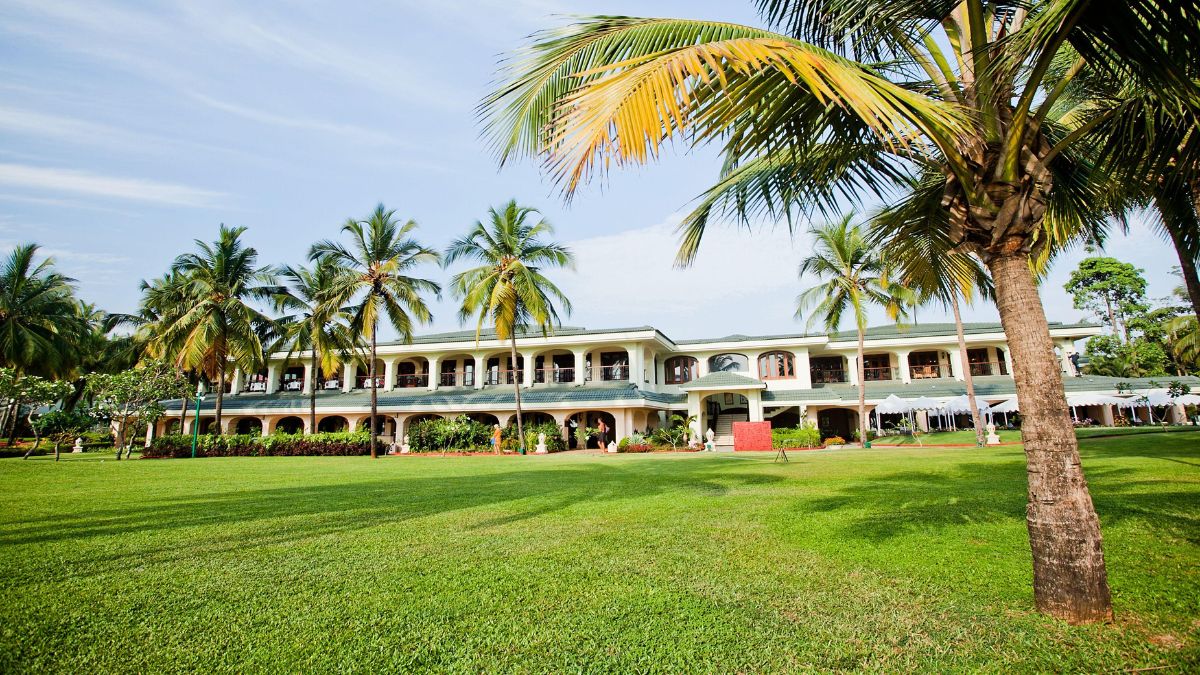
After the palaces, forts, and sacred cities, Taj Exotica Resort & Spa offers what every well-designed India itinerary eventually needs: a place to slow down entirely. Spread across 56 acres of tropical grounds on Benaulim Beach in South Goa, the resort draws on Mediterranean and colonial Goan-Portuguese design — terracotta roofs, whitewashed facades, wooden-beamed ceilings, and flower-lined stone patios — to create a low-density seaside retreat that feels distinctly Goan rather than generically tropical.
Dining reflects the region’s culinary identity, with Goan-Portuguese cuisine at the forefront. A nine-hole golf course, private beach access, plunge-pool villas, and a Jiva Spa round out the experience. Taj Exotica is the right property for families and couples who want to pair India’s cultural intensity with a genuine beach escape — ideally as the final chapter of a longer journey through Rajasthan, Mumbai, or the south.
Which Taj Property Is Right for Your India Journey?
Choosing between Taj properties depends less on star ratings — they are uniformly excellent — and more on what kind of India experience you are seeking.
For a first luxury trip to India, Rambagh Palace in Jaipur and the Taj Mahal Palace in Mumbai together offer the most comprehensive introduction: one rooted in Rajput royal heritage, the other in India’s modern urban story. For couples and honeymooners, Taj Lake Palace in Udaipur remains the most romantic choice in the portfolio, possibly in the country.
For a royal Rajasthan circuit, combining Rambagh Palace, Umaid Bhawan Palace, and either of Udaipur’s Taj palaces creates an itinerary spanning three dynasties and three distinct architectural traditions — a journey well suited to a wider Luxury Rajasthan Tours experience. For heritage lovers, Taj Falaknuma Palace in Hyderabad and Taj Usha Kiran Palace in Gwalior reward travellers who look beyond Rajasthan. For spiritual and cultural travel, Taj Nadesar Palace brings uncommon calm to a Varanasi stay. And for a beach escape to close an India journey, Taj Exotica in South Goa delivers the Susegad pace that Goa does best.
Frequently Asked Questions
Which is the most famous Taj property in India?
The Taj Mahal Palace in Mumbai is the most famous Taj property. As the founding hotel of IHCL, opened in 1903 by Jamsetji Tata, it predates the Gateway of India by two decades and has served as the symbolic anchor of Mumbai’s waterfront and India’s modern hospitality heritage ever since.
What is the best Taj property for a luxury stay in India?
There is no single best Taj property — the ideal choice depends on the destination and experience. Taj Lake Palace in Udaipur excels for romance, Rambagh Palace in Jaipur for royal grandeur, Taj Falaknuma Palace in Hyderabad for Nizam heritage, and the Taj Mahal Palace in Mumbai for a landmark city stay.
Which Taj Palace is best for a royal experience?
Rambagh Palace in Jaipur delivers the most complete royal experience among Taj properties. Its 47-acre estate was the private residence of Maharaja Sawai Man Singh II and Maharani Gayatri Devi, and dining in the Suvarna Mahal or visiting the Polo Bar places guests directly within Rajput courtly life.
Which Taj property is best for experiencing India’s royal heritage?
For depth of royal heritage, Taj Falaknuma Palace in Hyderabad and Umaid Bhawan Palace in Jodhpur stand apart. Falaknuma preserves the Nizam-era courtly world of the Deccan, while Umaid Bhawan — still partially a private Rathore residence — offers an Art Deco palace experience unique in Indian hospitality.
Which Taj property is best for a honeymoon in India?
Taj Lake Palace in Udaipur is widely considered the finest Taj property for a honeymoon. Its white-marble island setting on Lake Pichola, private-boat arrival, and views framed by the Aravalli Hills create an intimate atmosphere that few hotel settings anywhere can match.
What is the best Taj hotel in Rajasthan?
Rajasthan has the largest concentration of Taj palace hotels in India. Rambagh Palace suits travellers seeking royal scale in Jaipur, Taj Lake Palace offers the most iconic setting in Udaipur, and Umaid Bhawan Palace in Jodhpur combines Marwar heritage with rare Art Deco architecture and an active royal household.
Which Taj Palace is best in Udaipur?
Udaipur has two distinctive Taj palaces. Taj Lake Palace, set on an island in Lake Pichola, is ideal for couples and honeymooners seeking a romantic, secluded stay. Taj Fateh Prakash Palace, located within the City Palace complex, suits heritage-focused travellers who want to be embedded in Mewar’s living royal precinct.
Which Taj property is best for a luxury stay in Varanasi?
Taj Nadesar Palace is the premier Taj property in Varanasi. With only ten suites set within 32 acres of private mango orchards and jasmine gardens, it offers a rare combination of seclusion and proximity to the city’s sacred Ganges ghats — well suited to spiritual and cultural travellers.
Is Taj Lake Palace better for a romantic stay than Rambagh Palace?
Both are exceptional, but they deliver different experiences. Taj Lake Palace in Udaipur emphasises intimacy — a white-marble island, lake views, and quiet seclusion. Rambagh Palace in Jaipur offers royal grandeur across 47 acres of gardens and Rajput-era interiors. Couples seeking romance typically favour Udaipur; those drawn to palatial scale prefer Jaipur.
Are Taj Palace hotels worth staying at in India?
Taj palace hotels offer something beyond conventional luxury accommodation — stays within historically significant royal residences, each with distinct regional architecture, destination-rooted cuisine, and a service philosophy grounded in Indian tradition. For travellers who value heritage, a sense of place, and cultural depth, they represent some of the most distinctive stays in Asia.
Conclusion
India’s luxury hotel landscape has expanded considerably, but no brand has replicated what Taj Hotels has built over more than a century: a portfolio of properties where history, architecture, regional culture, and hospitality converge in a way that is distinctly and irreplaceably Indian. Staying at a Taj palace is not about thread counts or lobby design — it is about occupying spaces built by maharajas, nizams, and industrial visionaries, each anchored to a city and a story that gives the stay its meaning.
From the lake palaces of Mewar to the ghats of Varanasi and the shores of Goa, these properties offer one of the most layered and memorable ways to travel through India.
Planning a luxury journey through India? Explore our carefully designed private India tours and combine iconic destinations with exceptional heritage and luxury stays.