Best Luxury India Honeymoon Itineraries
 Best Luxury India Honeymoon Itineraries
No two couples travel the same way. Below are six genuinely different routes through India, each designed around a particular rhythm and set of priorities. Think of these as starting frameworks rather than fixed packages — the strongest India honeymoon journeys are always shaped around the couple.
1. Classic Royal Romance
Delhi – Agra – Jaipur – Udaipur
Best for: Couples experiencing India for the first time who want the essential highlights without a punishing pace.
Ideal duration: 10–12 nights
What makes it romantic: This route balances India’s most iconic moments with its most intimate ones. The Taj Mahal at first light, a private dinner arranged in a Jaipur palace garden, and then several unhurried days in Udaipur — widely regarded as India’s most romantic city.
Signature experiences: An early-morning private guided visit to the Taj Mahal, arriving as close to opening as possible when the light is softest and the crowds are thinnest. A heritage walking tour through Jaipur’s old city. A sunset boat ride on Lake Pichola with the City Palace behind you.
Where to slow down: Udaipur. Three nights minimum. Resist the urge to fill every hour and instead spend an afternoon by the pool at a lakeside palace hotel, or take a late-morning cooking class followed by lunch in a courtyard.
Accommodation style: Palace hotels and restored heritage properties. The Taj Lake Palace, Oberoi Udaivilas and Oberoi Rajvilas are reference points for the calibre of stay that defines this route.
Standout honeymoon moment: Dinner for two on a candlelit terrace overlooking Lake Pichola, with the Aravalli Hills darkening behind the water — an experience many of Udaipur’s finest hotels can arrange with advance notice.
2. Palaces & Wilderness
Delhi – Agra – Jaipur – Ranthambore – Udaipur
Best for: Couples who want India’s cultural heritage paired with the thrill and stillness of a wildlife experience.
Ideal duration: 12–14 nights
What makes it romantic: The contrast. One evening you are dining in a palace; the next morning you are sharing a quiet jeep, scanning the tree line for a Bengal tiger in Ranthambore. The shift from grandeur to raw nature creates a dynamic honeymoon with natural peaks and pauses.
Signature experiences: Morning and evening safari drives in Ranthambore, where tigers are sometimes spotted against the backdrop of a ruined 10th-century fort. A private guided walk through Jaipur’s Amber Fort. A traditional Rajasthani folk performance arranged at your hotel, where available.
Where to slow down: Ranthambore itself. Between drives, the best wilderness lodges offer genuinely peaceful downtime — nature walks, birdwatching from a private deck, long breakfasts with no agenda.
Accommodation style: Palace hotels in the cities with luxury safari lodges in Ranthambore. Properties like Aman-i-Khas and Suján Sher Bagh set the benchmark for refined wilderness stays.
Standout honeymoon moment: A dawn safari where the forest is still cool and quiet, birdsong layered over the distant call of a sambar deer — and then, if the forest cooperates, a tiger emerging through the mist. No sighting is ever guaranteed, which is precisely what makes it extraordinary.
3. Royal Rajasthan Romance
Jaipur – Jodhpur – Udaipur
Best for: Couples with limited time who want a focused, deeply atmospheric luxury Rajasthan honeymoon without the Delhi or Agra sections.
Ideal duration: 8–10 nights
What makes it romantic: Rajasthan distilled to its most vivid. The pink walls of Jaipur, the blue labyrinth of Jodhpur’s old city, the white palaces of Udaipur floating on silver lakes — each city has a distinct colour, character and mood.
Signature experiences: A private rooftop dinner overlooking Jodhpur’s Mehrangarh Fort — one of India’s most dramatic silhouettes after dark — can often be arranged through select properties. A guided textile and jewellery walk through Jaipur’s artisan quarters. A day trip to the Jain temples of Ranakpur, set in a forested valley between Jodhpur and Udaipur.
Accommodation style: Heritage hotels and boutique palace properties in each city. The strongest Rajasthan stays are not necessarily the largest or most famous, but those with character, attentive service and a sense of place.
Standout honeymoon moment: Arriving at Mihir Garh, a nine-suite fortress hotel rising from the Thar Desert outside Jodhpur, where the only neighbours are the dunes and the sunset is an event in itself.
4. Culture to Coast
Delhi – Agra – Rajasthan – Goa
Best for: Couples who want India’s cultural intensity balanced with genuine coastal relaxation.
Ideal duration: 12–16 nights
What makes it romantic: The journey has a built-in arc. The first week is active and immersive — forts, palaces, vibrant streets, early mornings. Then, a short flight south to Goa’s quieter coastline, where the pace drops entirely. Bare feet. Long lunches. The sound of the Arabian Sea.
Signature experiences: Rajasthan’s palaces and heritage by day, followed by South Goa’s beach life — morning yoga overlooking the ocean, sunset cruises on the Mandovi River and, depending on the property, private beach dinners arranged for couples.
Where to slow down: Goa. Choose South Goa for seclusion. Three to four nights allows couples to genuinely decompress after the richness of the north.
Accommodation style: Palace and heritage hotels in Rajasthan, transitioning to boutique beach resorts or private villas in Goa. Properties like Ahilya by the Sea, The Leela Goa and Elsewhere offer the right mood.
Standout honeymoon moment: A quiet evening on an empty stretch of Agonda beach — some of Goa’s better boutique properties can arrange candlelit dinners on the sand, though availability depends on the season and the hotel.
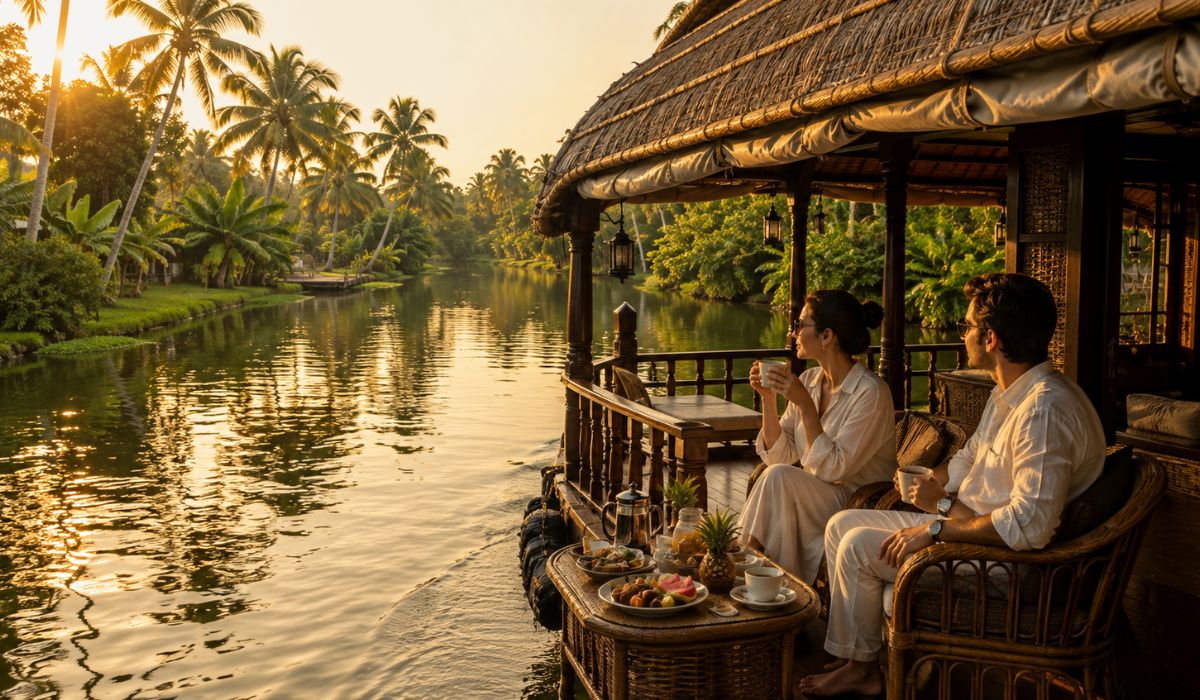
5. Slow Luxury & Wellness: A Kerala Honeymoon
Kochi – Munnar – Periyar – Alleppey / Kumarakom
Best for: Couples who want their honeymoon to feel restorative from the start. Nature, wellness, water and unhurried beauty.
Ideal duration: 10–14 nights
What makes it romantic: Kerala offers a fundamentally different India: lush, green, water-laced and gentle. Days unfold around morning mist on tea plantations, afternoon wellness treatments for two and evenings on a private houseboat drifting through the backwaters.
Signature experiences: An overnight private houseboat cruise through Kerala’s palm-fringed backwater canals — one of India’s most singular experiences. A couples’ Ayurvedic spa programme at a dedicated wellness retreat. A spice plantation walk in the hills of Thekkady. A cooking session learning to prepare a traditional Keralan sadya.
Those drawn to the backwater experience should explore the luxury Kerala honeymoon journey, which pairs the houseboat with Kerala’s highland landscapes and coastal retreats into a single, thoughtfully paced route.
For a deeper look at what the houseboat experience involves — the craft, the crew, the food, the pace — the guide to Kerala’s luxury houseboat experience is worth reading before you decide.
Where to slow down: The backwaters. A single overnight cruise is lovely; two nights allows the rhythm of the water to genuinely settle in.
Accommodation style: Boutique hillside retreats in Munnar, a wellness resort in Kumarakom or Marari, and a premium private houseboat on the backwaters. CGH Earth properties, Niraamaya Retreats and the Kumarakom Lake Resort set the tone.
Standout honeymoon moment: Waking at dawn on a houseboat, the engine off, surrounded by palm trees, still water and the sound of a kingfisher. Breakfast — appam, fish curry, fresh coconut — served on the upper deck as the world slowly begins to move.
6. India + Maldives Honeymoon
Rajasthan or Kerala + Maldives extension
Best for: Couples who want the cultural depth of India combined with the barefoot, overwater-villa ease of the Maldives.
Ideal duration: 14–18 nights total (8–12 in India, 4–6 in the Maldives)
What makes it romantic: India provides the story, the stimulation and the cultural richness; the Maldives provides the full stop — the place where you process everything you have experienced, floating in warm water with nothing on the agenda.
Signature experiences: The full India journey (palace stays, private experiences, wildlife or wellness — whichever itinerary above resonates most), followed by a transfer to a private island resort in the Maldives.
Accommodation style: India’s strongest palace or heritage hotels, followed by overwater or beach villas at resorts such as Soneva Fushi, One&Only Reethi Rah or Joali.
Standout honeymoon moment: The flight from India to the Maldives — watching the landscape shift from dusty gold to turquoise, knowing the next chapter of your honeymoon is about to be completely different.
Experiences Worth Travelling to India For
Beyond the itinerary, it is the individual moments that couples remember most vividly.
A sunrise visit to the Taj Mahal with a private guide. Arrive shortly before opening and enter as early as possible — in the first hour, the marble shifts from pale grey to warm gold and the grounds are considerably less crowded. A knowledgeable guide adds layers of meaning — the symmetry, the calligraphy, the story of Shah Jahan’s devotion — that a rushed group visit cannot offer.
A sunset on Lake Pichola. A small boat on the lake in Udaipur as the sun drops behind the Aravalli Hills. The City Palace and the Taj Lake Palace glow amber on the water. It is almost absurdly romantic.
A night in a palace that was someone’s home. Not a palace-themed hotel — an actual royal residence, converted with care, where the history is in the walls and the host family sometimes joins guests for dinner. Rajasthan has dozens of these properties, from intimate four-room havelis to grand lakeside estates.
A morning game drive in Ranthambore. India’s tiger reserves offer a form of safari distinct from East Africa — denser forests, the ruins of ancient fortifications, the knowledge that around any bend you might encounter a Bengal tiger. Sightings depend on wildlife movement and conditions, but the forest itself is worth the visit.
Ayurvedic wellness for two. Kerala’s wellness tradition draws on thousands of years of practice. The better retreats design multi-day programmes around each guest, combining treatments, diet and yoga into a genuinely restorative experience.
A chauffeur-driven journey through Rajasthan. There is something deeply appealing about being driven through Rajasthan — the changing light on sandstone forts, stops at local chai stalls, the freedom to pause whenever something catches your eye. A skilled driver and a good vehicle turn long transfers into one of the journey’s pleasures.
Why Accommodation Defines a Honeymoon in India
On any trip, hotels matter. On a honeymoon, they matter more. In India, they can matter most of all — because the country’s strongest properties are not just places to sleep; they are destinations in themselves.
Palace hotels such as the Taj Lake Palace, the Umaid Bhawan Palace in Jodhpur and the Oberoi Rajvilas in Jaipur offer a scale of grandeur and service that is difficult to replicate elsewhere.
Restored havelis and heritage homes — smaller, more personal, often family-run — provide an intimacy that larger properties cannot.
Luxury safari lodges in Ranthambore and other reserves bring international standards of design and comfort to the edge of the wilderness.
Wellness resorts in Kerala and the Himalayan foothills focus on restoration: traditional treatments, yoga, clean food, silence.
Beach resorts and private villas in Goa and Kerala’s coast offer barefoot ease with strong design sensibility — a welcome counterpoint to the ornate grandeur of the north.
The key insight: mixing property styles within a single honeymoon creates variety and contrast. Two nights in a palace, two in a safari lodge, two on a houseboat, two at a beach villa — each stay feels like a different chapter.
Planning an India Honeymoon From the USA
For American couples, India requires a genuine long-haul commitment — roughly 14 to 17 hours of flying, depending on routing. This makes trip duration particularly important: anything under 10 nights feels rushed once you account for arrival recovery and jet lag. Most couples find 12 to 16 nights to be the range where the journey feels rewarding without becoming a marathon.
Because the time difference is substantial (9.5 to 12.5 hours ahead), building in a recovery day on arrival — even at a comfortable Delhi hotel — pays dividends for the rest of the trip. Couples who push straight into sightseeing on arrival day often regret it by day three.
Major international gateways offer a range of one-stop and, on selected routes, nonstop connections to Delhi, with domestic onward flights to Rajasthan, Kerala and Goa.
Planning an India Honeymoon From Canada
Canadian couples face similar flight logistics, with connections typically routing through the Middle East, London or major US hubs. The travel commitment is long enough that combining India with a Maldives extension makes strong practical sense — you have already committed to the journey, so extending it by four or five nights feels less like an indulgence and more like a logical conclusion.
Seasonality deserves attention: many Canadian couples plan honeymoons around summer wedding dates, but India’s most comfortable travel season runs from October through March in the north. Aligning wedding timing with India’s regional climate is one of the first practical conversations worth having with a specialist.
Planning an India Honeymoon From the UK
India works particularly well for British couples. Flight times are manageable — around 8 to 9 hours from London — making even a 10-night honeymoon feel proportionate. The time difference is modest, so jet lag is minimal compared to long-haul alternatives like the Caribbean or Southeast Asia.
The UK also benefits from good connectivity to several Indian cities beyond Delhi, which can open up itinerary options that bypass the capital entirely. A focused Rajasthan circuit or a journey combining Rajasthan with Kerala is entirely comfortable from a UK departure point.
For couples marrying in the British summer, October and November represent a strong window — the monsoon has cleared, temperatures in Rajasthan are warm but not oppressive, and Kerala’s landscape is at its greenest.
When to Go: Timing Your India Honeymoon
October through March is the prime season for North India — Rajasthan, the Taj Mahal, Ranthambore and Delhi. Temperatures are comfortable, skies are clear and the light is at its best.
Kerala is well-suited from September through March, with October and November offering the lushest post-monsoon landscapes.
Goa peaks from November through February, when humidity drops and the beaches are at their finest.
Monsoon season (June through September) is generally best avoided for a honeymoon, though parts of Kerala and select Rajasthan properties can be atmospheric and considerably less crowded.
The practical takeaway: if your wedding falls between October and February, India’s timing aligns well with a honeymoon departure. If your wedding is in summer, consider a delayed trip or a Kerala-focused honeymoon in September or October.
What Affects the Cost of a Luxury India Honeymoon?
Pricing a luxury India honeymoon depends on several interlocking factors, and quoting a single figure would be misleading. The variables that shape cost most significantly are:
- Accommodation tier. The difference between a well-reviewed heritage hotel and a top-tier palace suite can be substantial, and peak season (December–January) commands premium rates at India’s most sought-after properties.
- Travel style. Private chauffeur-driven journeys with a dedicated guide cost more than self-guided travel, but they remove every logistical friction point — and on a honeymoon, that matters.
- Internal flights. Domestic flights between regions add up across a multi-stop itinerary.
- Experiences. Private safari drives, curated dinners, wellness programmes and cultural experiences each layer onto the base cost.
- Duration and routing. A focused 10-night Rajasthan honeymoon costs considerably less than a 16-night journey combining Rajasthan, wildlife, Kerala and the Maldives.
Because cost varies so widely, the most useful step is to share your preferred dates, duration, hotel style and interests with a specialist who can provide realistic pricing for your specific journey. Booking premium properties six to nine months in advance is advisable, particularly for peak-season travel and India’s most popular palace hotels.
Rajasthan or Kerala? Choosing the Right Honeymoon Style
This is one of the most common questions couples ask, and the honest answer is that they offer entirely different experiences — neither is objectively “better” for a honeymoon.
Choose Rajasthan if you are drawn to history, grandeur, colour, architecture and palace living. Rajasthan is visually dramatic and culturally rich.
Choose Kerala if you want nature, water, wellness and a gentler rhythm from the start. Kerala is calmer, greener and more contemplative. It suits couples who find their romance in quietude rather than spectacle.
Choose both if your schedule allows 14 nights or more. A Rajasthan-to-Kerala journey — palace grandeur in the north followed by tropical stillness in the south, connected by a short domestic flight — is one of the most satisfying honeymoon arcs India can offer.
If you are exploring a private Kerala houseboat itinerary as part of a wider India honeymoon, it pairs naturally with a shorter Rajasthan opening of four or five nights, creating contrast without overloading the schedule.
Practical Advice for Honeymoon Couples
Build in unscheduled time. The most common honeymoon planning mistake in India is booking every morning and afternoon with activities. Leave space for spontaneity — a late breakfast, an unplanned walk, an afternoon doing nothing at all.
Stay two or three nights per destination. Changing hotels daily is fatiguing and leaves no time to settle into a place. In Udaipur, Goa or the Kerala backwaters especially, an extra night transforms the experience.
Use domestic flights for long distances. The drive from Jaipur to Udaipur is scenic but long. A short flight preserves energy. Between Rajasthan and Kerala or Goa, flying is essential.
A private driver is worth it. A skilled driver with a well-maintained vehicle provides comfort, flexibility and freedom across India’s varied road conditions, and turns transfers between cities into part of the experience rather than a chore.
Frequently Asked Questions
Is India suitable for a luxury honeymoon?
Yes. India’s palace hotels, private travel infrastructure and tradition of personalised hospitality are world-class. The combination of heritage accommodation, cultural depth and natural beauty makes India one of the most rewarding honeymoon destinations available, provided the itinerary is designed with care.
How many days do you need for a honeymoon in India?
A minimum of 10 nights is recommended for international couples. Twelve to sixteen nights allows a comfortable pace and the ability to include multiple regions. Shorter trips should focus on a single region rather than attempting to cover too much ground.
What is the best time of year for a honeymoon in India?
October through March for North India (Rajasthan, Agra, Delhi, Ranthambore). September through March for Kerala. November through February for Goa. The monsoon months of June through September are generally best avoided.
Should we combine India with the Maldives?
If your schedule and budget allow it, an India + Maldives honeymoon is one of the strongest combinations in Asia. India provides cultural richness and variety; the Maldives provides a restful conclusion. Four to six nights in the Maldives after eight to twelve in India strikes a good balance.
How far in advance should we book?
Six to nine months is advisable for peak-season travel (November through February), particularly if you want specific suites at India’s most popular palace hotels. Room counts at properties like the Taj Lake Palace and Oberoi Udaivilas are limited, and honeymoon-suitable suites book early.
Can we have a private experience at the Taj Mahal?
The Taj Mahal is a public monument and cannot be privately booked. However, visiting at sunrise — arriving shortly before the gates open and entering as early as possible — with a knowledgeable private guide creates a far more intimate experience than arriving mid-morning with a group. The early light is also considerably better for photographs.
Is a private driver necessary?
For a honeymoon, strongly recommended. A private chauffeur-driven vehicle provides comfort, flexibility and safety across India’s varied road conditions, and allows couples to enjoy the landscape between destinations rather than navigating logistics themselves.
Begin Planning Your Private India Honeymoon
The most memorable India honeymoons are not assembled from a catalogue — they are designed through conversation. Your wedding dates, preferred pace, accommodation tastes, interests and tolerance for activity versus stillness all shape the journey differently.
If you are weighing Rajasthan’s palace hotels against Kerala’s backwaters, considering whether to add a few quiet days by the coast or extend to the Maldives, the most useful next step is a conversation with someone who knows these destinations intimately.
Request a personalised India honeymoon itinerary — share your dates, your priorities and your preferences, and let a specialist build a journey that belongs entirely to you.