1. Stay in India’s Iconic Palace Hotels
India’s palace hotels are not simply places to sleep. They are living monuments — working museums where you happen to have a room key.
The Oberoi Amarvilas, Agra sits 600 metres from the Taj Mahal. Every room, every suite, every public terrace offers an unobstructed view of the monument. The Mughal-inspired architecture features cascading fountains, terraced gardens and interiors that reference the geometric precision of Islamic art without ever feeling heavy or dated. Service here is the kind of attentive that borders on telepathic — your morning tea appears at exactly the right temperature, your evening turndown includes handwritten notes about the next day’s weather. Rates for a premier room begin around $600 per night, rising sharply for the Kohinoor Suite.
Rambagh Palace, Jaipur — a Taj Hotels property — was the former residence of the Maharaja of Jaipur until 1957. The 47 acres of Mughal gardens, the indoor pool lined with mosaic tiles and the grand dining room where the royal family once entertained dignitaries create an atmosphere that hovers between living history and unapologetic grandeur. Suites bear the names of former royals. The spa uses Ayurvedic treatments developed from recipes in the palace archives. Afternoon tea on the verandah, overlooking manicured lawns where peacocks strut, remains one of India’s finest luxury rituals.
The Imperial, New Delhi occupies a singular position among the capital’s hotels. Built in 1931, it houses one of Asia’s largest private art collections — more than 5,000 pieces, including original works from the Company School and Daniell aquatints. The Art Deco architecture, the colonnaded corridors and the 1911 restaurant (named for the year the capital shifted to Delhi) make this a property that appeals equally to design enthusiasts and history scholars. The Imperial is where heads of state stay. It is also where discerning couples celebrate anniversaries far from the noise of newer, flashier hotels.
These three properties alone justify the Golden Triangle as a luxury destination. Together, they offer a survey of Indian hospitality at its most polished — from Mughal to Rajput to colonial, each with a distinct character and a shared commitment to excellence.
2. Experience a Private Sunrise at the Taj Mahal
The Taj Mahal opens at sunrise, and those first thirty minutes — before the tour buses arrive, before the heat builds, before the monument fills with thousands of visitors — are sacred.
A private sunrise visit to the Taj Mahal is the single most unforgettable experience in the Golden Triangle. The gates open at 6:00 AM (or at first light, depending on the season), and with a knowledgeable guide at your side, you enter through the south gate into a stillness that feels almost rehearsed in its perfection.
The marble changes colour with the light. In the first minutes after sunrise, it glows a soft pink — the result of the semi-precious stones inlaid across its surface catching the low-angle rays. As the sun climbs, the monument shifts through rose, cream and finally the luminous white that photographs have made famous. Your guide will position you at the Diana Bench — the same vantage point where Princess Diana was photographed in 1992 — and explain the pietra dura inlay work, the optical illusions built into the minarets and the love story of Shah Jahan and Mumtaz Mahal with the kind of detail that transforms a monument into a narrative.
Photography tip: The best images are captured between 6:00 and 6:45 AM, when the light is warm and directional and the crowds are thin enough to frame the Taj without distracting figures. A wide-angle lens (16–35mm) captures the full monument from the reflecting pool; a telephoto (70–200mm) isolates the inlay details on the central dome.
After the visit, the finest way to end the morning is with a luxury breakfast at the Oberoi Amarvilas — ideally on the terrace, where the Taj remains visible through the morning haze while you work through a spread of freshly baked pastries, seasonal fruits and eggs prepared to order.
This early access, paired with expert commentary and the right hotel nearby, is the kind of luxury Taj Mahal tour experience that turns a visit into something genuinely moving.
3. Enjoy Royal Fine Dining
Indian cuisine at this level has nothing to do with the curry houses of London or the tikka masala of suburban strip malls. Dining within the Golden Triangle’s finest properties is a study in refinement, regional specificity and centuries-old technique.
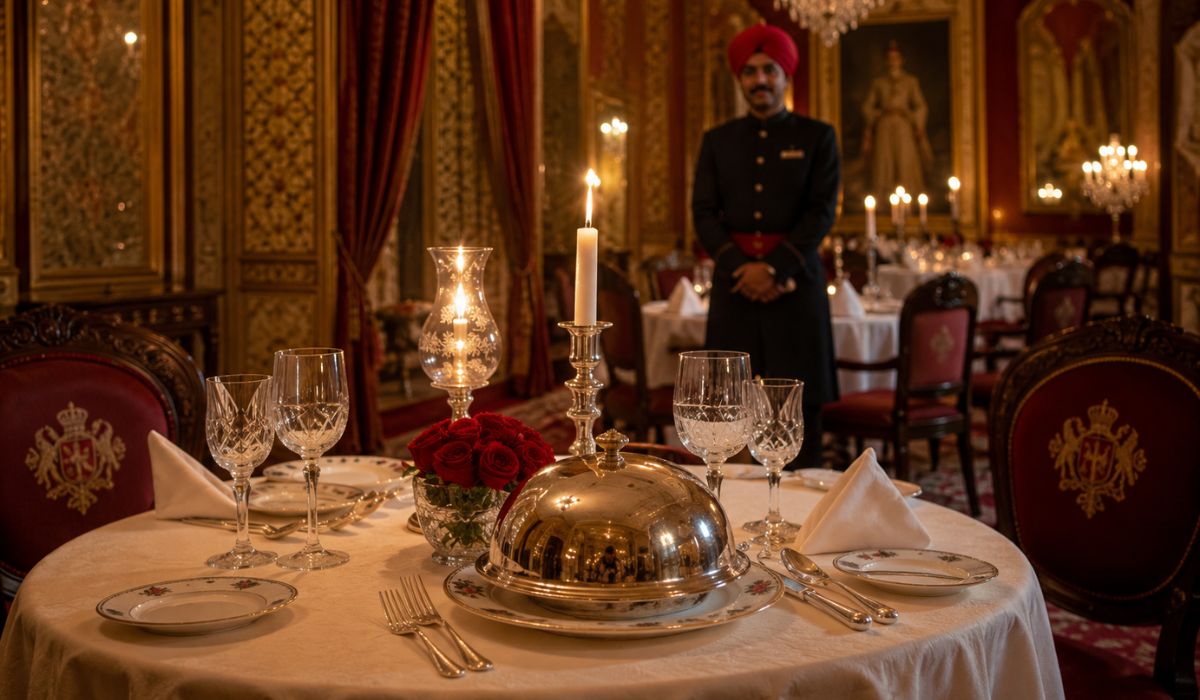
Rajput and Mughlai cuisine form the backbone of royal dining in Rajasthan and Agra. At Rambagh Palace’s Suvarna Mahal — a gold-leafed dining room that once served as the maharaja’s banquet hall — dishes like laal maas (slow-cooked Rajasthani lamb in red chilli) and safed maas (lamb in a white almond and cashew sauce) are prepared from recipes that predate the restaurant by 200 years. The wine list includes Indian vintages from Nashik Valley alongside French and Italian estates, and the sommelier is skilled at pairing bold Indian flavours with unexpected bottles.
Private dining experiences can be arranged at most luxury properties. At the Oberoi Amarvilas, a candlelit dinner beside the reflecting pool — with the Taj Mahal illuminated in the background — is available for guests booking suites. At The Imperial in Delhi, private meals in the Daniell’s Tavern, surrounded by original 18th-century paintings, create an atmosphere that feels more like dining in a collector’s private gallery than a restaurant.
Street food, elevated. The best guides in Old Delhi will take you on a private food walk through Chandni Chowk — India’s oldest and most revered food market — where you’ll taste dishes at stalls that have been operating for three or four generations. Paranthe Wali Gali (the street of fried breads), Natraj’s dahi bhalla, and the kulfi at Kuremal — these aren’t tourist stops. They’re pilgrimages that serious food travellers make again and again.
For couples celebrating special occasions or honeymooners seeking romance, a private rooftop dinner under the stars — arranged through your tour — transforms an evening meal into an event.
4. Discover Delhi with a Private Expert Guide
Delhi rewards slow, curious exploration — and it punishes rushed, superficial visits. A private guide changes everything.
Old Delhi is a city within a city: a walled, Mughal-era labyrinth of narrow lanes, 17th-century mosques, Sikh temples and wholesale markets that move at a rhythm entirely their own. With a guide, you navigate the chaos comfortably. You visit the Jama Masjid — India’s largest mosque, built by Shah Jahan in 1656 — and climb the southern minaret for a panoramic view of the old city. You duck into Haveli Dharampura, a restored 19th-century mansion in the heart of the old quarter, for a rooftop lunch above the noise.
New Delhi offers a different kind of grandeur. The Lutyens’ Bungalow Zone — designed by British architect Edwin Lutyens in the 1920s — is a tree-lined district of white colonial mansions, embassies and government buildings that feels closer to Washington, D.C. than to the India most visitors expect. Humayun’s Tomb, the 16th-century precursor to the Taj Mahal, is a revelation in itself — and significantly less crowded.
Hidden gems that a private guide unlocks include the Agrasen ki Baoli, a 14th-century stepwell now hemmed in by modern office towers; the Lodhi Art District, where enormous murals cover the walls of an entire neighbourhood; and the Nizamuddin Dargah, a 700-year-old Sufi shrine where qawwali devotional music fills the courtyard on Thursday evenings.
Luxury experiences in Delhi also include exclusive access to designer studios in the Mehrauli and Hauz Khas neighbourhoods, private gallery openings and guided visits to the National Museum’s reserve collections — experiences that no standard tour includes.
5. Explore Amber Fort Like Royalty
Amber Fort rises from the Aravalli Hills above Jaipur like something from a fever dream — enormous, honeycombed with courtyards and corridors, and far more beautiful inside than its imposing sandstone exterior suggests.
Built in 1592 by Raja Man Singh I, Amber Fort (also spelled Amer) blends Rajput military architecture with Mughal decorative refinement. The Sheesh Mahal — the “Hall of Mirrors” — is its centrepiece: a chamber encrusted with thousands of convex mirror fragments that, when a single candle is lit, create the illusion of a starlit sky overhead. The effect is genuinely breathtaking and is best appreciated with a guide who can explain the craftsmanship involved.
A private jeep ride up the cobblestoned ramp to the fort entrance is the preferred method of arrival (elephant rides, though traditional, are increasingly discouraged on animal welfare grounds). The jeep deposits you at the Suraj Pol — the Sun Gate — and from there, the fort unfolds room by room: the Diwan-i-Aam (public audience hall), the Diwan-i-Khas (private audience hall), the zenana (women’s quarters) and the Mughal garden modelled on the Shalimar Bagh in Kashmir.
Photography opportunities are exceptional. The best vantage point for the full fort complex is from the Maota Lake embankment, where the reflection doubles the structure in the morning light. Inside, the geometric patterns of the Ganesh Pol gateway are among the most photographed details in all of Rajasthan.
For travellers planning a luxury tour of Delhi, Agra & Jaipur, Amber Fort is typically the highlight of the Jaipur section — and with good reason.
6. Shop with a Personal Luxury Guide
Jaipur is India’s undisputed capital of luxury craftsmanship, and shopping here — when done properly — is one of the defining pleasures of the Golden Triangle.
Gemstones and fine jewellery are Jaipur’s speciality. The city has been a global centre for gemstone cutting and polishing since the 18th century, and today its workshops produce some of the finest emeralds, sapphires, rubies and tanzanite in the world. A personal shopping guide — typically someone with deep relationships in the gem trade — will take you to trusted ateliers rather than tourist-facing shops, where you can watch master cutters at work and purchase certified stones at workshop prices. The Johari Bazaar, the traditional jewellers’ market, remains the heart of this trade.
Handcrafted textiles — including block-printed cottons, bandhani (tie-dye), and fine pashmina — are another Jaipur strength. The studios of Anokhi and the workshops in Sanganer (15 kilometres south of the city) are worth the visit for anyone with an interest in textile arts. A skilled guide ensures you see the actual production process, not a staged demonstration.
Luxury carpets, particularly hand-knotted silk-on-silk pieces, are available at a fraction of their retail price in London or New York. Reputable dealers will ship internationally and provide certificates of origin.
Designer boutiques in Jaipur’s Civil Lines neighbourhood stock contemporary Indian fashion by designers such as Sabyasachi, Anita Dongre and Raw Mango — names that are increasingly familiar on international red carpets.
A personal luxury guide removes the uncertainty from the process. They negotiate on your behalf, verify authenticity and ensure that purchases are shipped or packed safely — all of which makes shopping here a pleasure rather than a gamble.
7. Enjoy Exclusive Sunset Experiences
The golden hour in Rajasthan is unlike anywhere else on earth. The desert air, low humidity and the warm tones of sandstone and marble conspire to produce sunsets of almost theatrical intensity.
Luxury rooftop experiences in Jaipur offer the finest vantage points. Several high-end properties arrange private sundowner sessions on their terraces — cocktails in hand, the silhouette of Nahargarh Fort cutting across the sky — that feel less like a hotel amenity and more like a private screening of something extraordinary. The rooftop bar at the Oberoi Rajvilas, framed by bougainvillea and flickering lanterns, is a favourite among returning guests.
In Agra, the Mehtab Bagh — a Mughal garden on the opposite bank of the Yamuna River from the Taj Mahal — provides what is arguably the most romantic sunset view in India. The Taj, viewed from the north with the setting sun behind you, takes on a golden warmth that photographs from the main complex cannot capture. Access is straightforward, but a private guide ensures you arrive at the optimal time and secure the best position.
Golden hour photography at these locations produces images of rare quality. The warm, diffused light is flattering both for architecture and for portraits, and a guide who understands photography will position you for the best compositions without the need for a dedicated photographer.
Private cocktail arrangements — a gin and tonic made with Indian craft gin, or a champagne service overlooking the city walls — can be organised through your tour. These aren’t listed in any hotel brochure. They’re the kind of detail that a seasoned travel specialist arranges because they know it matters.
8. Travel in Ultimate Comfort
The distances in the Golden Triangle are manageable — Delhi to Agra is 230 km, Agra to Jaipur is 240 km, and Jaipur back to Delhi is 270 km — but the quality of the journey depends entirely on the vehicle and the driver.
Luxury Golden Triangle tours typically provide one of the following:
- Mercedes-Benz E-Class — the standard for executive-level touring, offering superb ride comfort, whisper-quiet interiors and ample legroom
- BMW 5 Series — preferred by travellers who appreciate a slightly sportier driving character with identical comfort levels
- Toyota Vellfire — the choice for families or those who want maximum cabin space, with captain’s chairs, a sliding rear door and enough room to stretch fully
- Luxury SUVs (Toyota Fortuner or equivalent) — better suited to journeys involving unpaved roads, such as the route to Ranthambore National Park
Professional chauffeurs are as important as the vehicle itself. The best drivers on this circuit have years of highway experience, maintain conservative speeds and keep the vehicle immaculately clean. They handle toll gates, fuel stops and the occasional traffic negotiation with military precision, allowing you to read, nap or simply enjoy the passing landscape of mustard fields, Rajasthani villages and the occasional camel caravan.
All vehicles are air-conditioned, stocked with bottled water, and equipped with USB charging ports and Wi-Fi. For longer drives, cold towels and light snacks are provided.
The result is that the journey between cities — often the most dreaded part of Indian travel — becomes one of the most relaxing.
9. Relax with Luxury Spa & Wellness
India is the birthplace of Ayurveda, the 5,000-year-old system of medicine and wellness, and the Golden Triangle’s finest hotels offer spa experiences that go far beyond a standard massage.
Ayurvedic treatments at properties like the Oberoi Rajvilas in Jaipur are designed around your individual dosha (body constitution), determined through a consultation with a resident Ayurvedic practitioner. Treatments include Abhyanga (a synchronised four-hand oil massage), Shirodhara (warm oil poured continuously over the forehead to calm the nervous system) and Udvartana (an herbal body scrub using aromatic powders). These aren’t abbreviated spa-menu versions — they’re full-duration treatments that follow classical Ayurvedic protocols.
Palace wellness rituals at Rambagh Palace draw on royal bathing traditions. Rose petal baths, sandalwood body wraps and turmeric-and-milk facials reference recipes from the maharani’s personal beauty archives. The setting — a treatment room within a converted palace wing, with filigreed screens filtering the afternoon light — makes the experience feel ceremonial rather than commercial.
At The Imperial, New Delhi, the spa combines Western techniques with Indian ingredients: Himalayan salt scrubs, Kerala-sourced coconut oil, and aromatherapy using attars (natural perfumes) distilled in Kannauj, a small Uttar Pradesh town that has supplied the Indian perfume trade for centuries.
For travellers arriving from long-haul flights, scheduling a 90-minute Ayurvedic treatment on the first evening in Delhi is the single best antidote to jet lag — and sets the tone for the days ahead.
10. Personalise Your Journey
The finest Golden Triangle experiences are the ones that don’t appear on standard itineraries — the moments that are tailored specifically to your interests, curiosity and pace.
Private cooking classes with palace chefs or home cooks offer a hands-on introduction to Indian cuisine. In Jaipur, you might spend a morning in the kitchen of a Rajput family learning to prepare dal baati churma (the quintessential Rajasthani dish) and kachori. In Delhi, a masterclass in Mughlai biriyani — the rice dish that separates a good Indian cook from a great one — teaches techniques passed down through generations.
Private cultural performances can be arranged at heritage properties: a Rajasthani folk dance troupe performing in a palace courtyard, a sitar recital in a candlelit garden, or a Kathak dance demonstration by a classically trained artist. These aren’t the large-scale dinner shows offered at tourist hotels — they’re intimate, high-quality performances arranged exclusively for your group.
Photography tours with local professionals are ideal for serious enthusiasts. In Old Delhi, a photography walk through the lanes of Chandni Chowk — timed for the morning light, when the spice market is at its most photogenic — produces images that capture the texture of daily life. In Jaipur, a dawn session at the Panna Meena ka Kund stepwell (one of Rajasthan’s most symmetrical and undervisited monuments) is a favourite among photography guides.
Village experiences outside Jaipur offer a glimpse of rural Rajasthani life: block-printing workshops, camel rides through the Aravalli foothills, and meals prepared in a traditional mud-and-thatch kitchen. These excursions take half a day and provide a counterpoint to the grandeur of the palace hotels.
The best luxury India tours are the ones that flex around you — and personalisation is what distinguishes a good holiday from an extraordinary one.