Luxury Golden Triangle Tour vs Standard Golden Triangle Tour: Which One Is Worth It?
A Luxury Golden Triangle Tour offers private chauffeur transfers, five-star palace hotels, expert licensed guides, and curated experiences across Delhi, Agra, and Jaipur — all at a significantly higher price than a standard tour. If comfort, privacy, and depth of experience matter to you, the luxury version is absolutely worth the investment. Budget travelers who simply want to cover the key sights can do well with a standard tour.
Introduction
The Golden Triangle — connecting Delhi, Agra, and Jaipur — is one of the most iconic travel circuits in the world. Every year, hundreds of thousands of international visitors traverse this 720-kilometre loop to witness the Taj Mahal, Agra Fort, Amber Fort, City Palace Jaipur, and the living heritage of Old Delhi.
But not all Golden Triangle tours are created equal.
There’s a world of difference between a standard group tour and a Luxury Golden Triangle Tour. One gets you from point A to B with a shared bus and fixed itinerary. The other gives you a private air-conditioned vehicle, a five-star heritage hotel, a specialist guide who adjusts the day around your pace — and experiences that most tourists never access.
So which one is right for you? This guide breaks down everything you need to know, from accommodation and transport to dining, sightseeing, and value for money.
What Is a Standard Golden Triangle Tour?
Quick Answer
A standard Golden Triangle Tour is a pre-packaged, fixed-itinerary trip covering Delhi, Agra, and Jaipur over 5–7 days. It typically uses budget to mid-range hotels, shared group transport, and a set sightseeing schedule with limited flexibility.
Typical Features
Standard tours are designed for efficiency and affordability. You’ll typically travel in a shared air-conditioned vehicle or mini-coach with other tourists, stay in three-star or upper mid-range hotels, and follow a tightly scheduled daily program. Meals may or may not be included, and guides are often shared across the group.
Entry tickets, basic travel insurance, and hotel transfers are usually bundled into a single package price, making it easy to book and budget for.
Advantages
- Affordable pricing — Standard packages can range from USD 300 to USD 800 per person, making them accessible to a wide range of travelers.
- Simple logistics — Everything is pre-arranged, so first-time India visitors don’t need to manage bookings independently.
- Social element — Traveling with others can be enjoyable for solo travelers or those who prefer group dynamics.
- Covers the essentials — You will visit the Taj Mahal, Agra Fort, Amber Fort, and Qutb Minar — the headline attractions are all included.
Limitations
The trade-offs are significant. Group tours move at the pace of the slowest member, not your personal preference. Early-morning Taj Mahal visits — widely considered the finest experience — are rare on standard itineraries. Hotel quality varies considerably, and dining is often limited to buffet-style tourist restaurants.
Personalization is minimal. If you want to linger in the textile bazaars of Jaipur or spend an extra hour watching the Agra skyline from your hotel balcony, a standard package rarely accommodates that.
What Is a Luxury Golden Triangle Tour?
Quick Answer
A Luxury Golden Triangle Tour is a private, fully customized travel experience across Delhi, Agra, and Jaipur, featuring five-star and heritage palace hotels, dedicated expert guides, private chauffeur-driven vehicles, and exclusive cultural experiences not available on standard tours.
Key Features
The defining characteristics of a luxury Golden Triangle holiday are privacy, personalization, and quality of experience at every touchpoint. From the moment you land, a private transfer picks you up in a premium vehicle. Your guide — often a historian or certified cultural specialist — accompanies you exclusively throughout the journey.
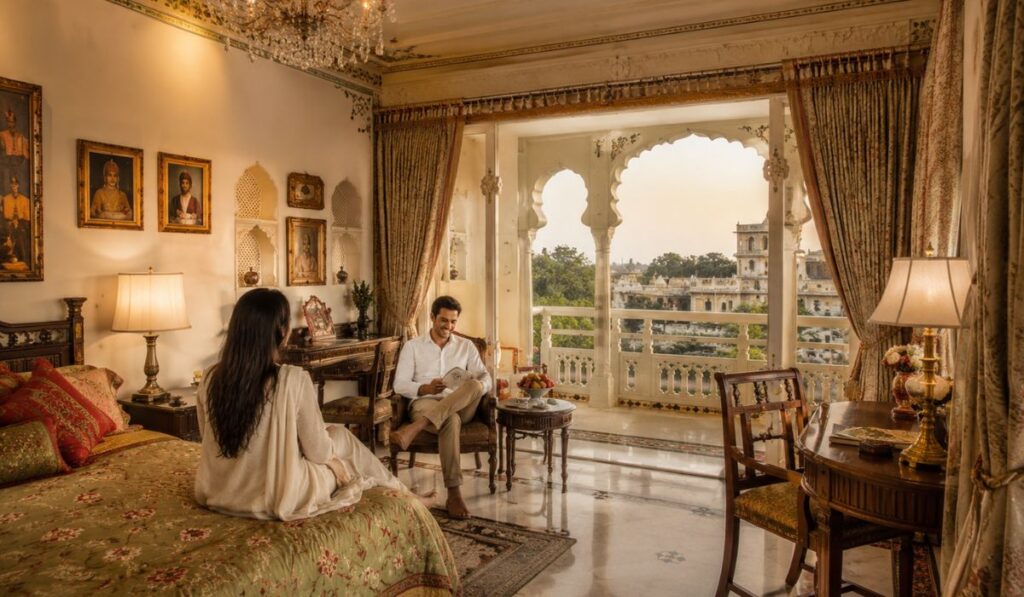
Accommodation moves into a different league entirely: think the Oberoi Amarvilas in Agra (where every room faces the Taj Mahal), the Rambagh Palace in Jaipur (a former royal residence of the Maharaja), or the ITC Maurya in Delhi. These aren’t just hotels — they’re part of the experience.
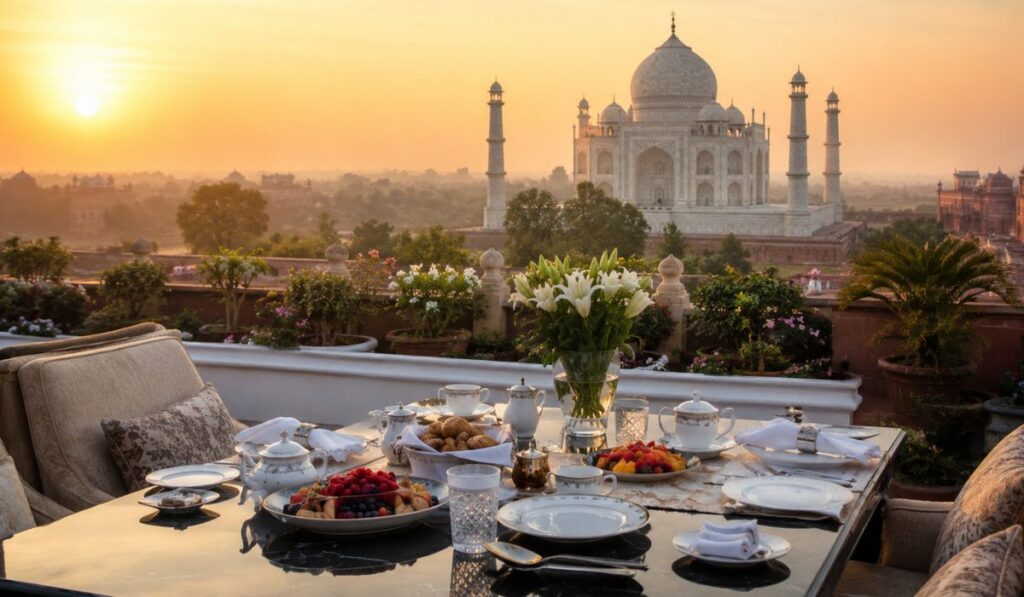
Experiences are curated around your interests. Art lovers get access to private Mughal manuscript collections. Foodies enjoy chef-curated dinners featuring royal Rajasthani cuisine. Honeymooners can arrange a private Taj Mahal sunrise visit followed by breakfast on a riverside terrace.
Benefits
- Total privacy — No shared coaches, no group schedules, no waiting.
- Flexible itineraries — Days adjust to your pace and preferences.
- Superior accommodation — Heritage palaces, five-star resorts, and landmark properties.
- Specialist guides — Deep-knowledge experts in Mughal history, Rajput architecture, and Indian culture.
- Exclusive access — Early-morning monument visits, private cooking classes, behind-the-scenes cultural encounters.
- Seamless logistics — Every transfer, ticket, and reservation handled by your operator.
Why Luxury Travelers Prefer It
For high-net-worth travelers, time is the scarcest resource. A Private Luxury Tour of India eliminates the friction that often frustrates independent travel in India — the unpredictability of taxis, the noise of tourist crowds, the unreliable mid-range restaurant. Instead, every element has been vetted, pre-arranged, and elevated.
India’s heritage is best understood slowly, in context, with someone who can explain why the geometric inlay on a Mughal arch took seventeen years to complete. Luxury tours provide that depth.
Luxury Golden Triangle Tour vs Standard Golden Triangle Tour: A Detailed Comparison
| Feature | Standard Tour | Luxury Tour |
|---|---|---|
| Hotels | 3–4 star hotels | 5-star / Heritage palace hotels |
| Transportation | Shared coach or basic sedan | Private premium AC vehicle |
| Tour Guide | Shared group guide | Dedicated specialist guide |
| Dining | Buffet / tourist restaurants | Fine dining / curated royal cuisine |
| Flexibility | Fixed itinerary | Fully customizable |
| Privacy | Group travel | 100% private |
| Comfort | Standard | Premium at every touchpoint |
| Experiences | Standard monument visits | Sunrise access, heritage walks, private events |
| Pricing (per person) | USD 300–800 | USD 1,500–6,000+ |
Accommodation Comparison
On a standard tour, expect clean, functional hotels in the three-star category — adequate for sleep but rarely memorable. Properties are often located on the outskirts of city centers, adding travel time to each sightseeing day.
On a luxury Delhi Agra Jaipur tour, accommodation becomes a highlight in itself. The Oberoi Amarvilas places you 600 meters from the Taj Mahal. The Rambagh Palace in Jaipur was once the official guesthouse of the Jaipur royal family. The Leela Palace Delhi sits near Diplomatic Enclave and offers butler service, spa facilities, and award-winning fine dining. These properties routinely feature in Condé Nast Traveller’s top hotels in Asia.
Transportation Comparison
Standard tours use shared coaches or economy sedans. Journey times between cities — Delhi to Agra is approximately 3–4 hours, Agra to Jaipur around 4–5 hours — can be uncomfortable in basic vehicles, particularly in summer heat.
Luxury tours use premium vehicles: Toyota Innova Crysta, Mercedes E-Class, or equivalent. Vehicles are climate-controlled, cleaned before each journey, stocked with water and refreshments, and driven by experienced, vetted chauffeurs who know the routes well. For longer journeys, some operators offer business-class train upgrades on the Gatimaan Express or Shatabdi Express.
Tour Guide Experience
A standard guide covers the facts — dates, dimensions, historical names. They’re knowledgeable, but they’re dividing their attention across ten or twelve travelers simultaneously.
A dedicated luxury guide is a different engagement entirely. Many are historians, trained archaeologists, or specialists in Mughal or Rajput heritage. They know which angle of Agra Fort catches the light at 4pm. They can take you to the inlay craftsmen’s workshops where pietra dura techniques have been passed down for four centuries. They adapt the narrative to what genuinely interests you.
Dining Experience
Standard tours default to tourist-belt restaurants: reliable, inoffensive, and largely identical. The food is safe but rarely distinctive.
Luxury itineraries prioritize culinary authenticity. A private chef’s table at a Jaipur palace, a cooking lesson with a royal family’s former head cook, rooftop dinner overlooking the Taj Mahal at dusk — these experiences stay with travelers long after the trip ends. Fine dining experiences in India’s top heritage properties rival those in any global city.
Sightseeing Experience
Both tour types visit the same core monuments: the Taj Mahal, Agra Fort, Qutb Minar, Humayun’s Tomb in Delhi, Amber Fort, City Palace Jaipur, and Jantar Mantar. The difference is entirely in how you experience them.
Luxury tours include early-morning access to the Taj Mahal before crowds arrive — typically before 7am when the light is finest and the marble glows pink-gold. Private guides provide contextual storytelling that transforms a sightseeing visit into a genuine cultural education. Some operators arrange access to areas not open to general visitors.
Flexibility and Personalization
Standard tours have fixed departure dates, fixed hotel check-ins, and fixed sightseeing schedules. If your flight lands late or you want an extra afternoon exploring Jaipur’s Old City bazaars, the itinerary doesn’t adjust.
Luxury India Tour Packages are built around your dates, preferences, and pace. Want to add a day in Agra to visit Fatehpur Sikri? Done. Prefer a wellness morning at a spa rather than a second fort visit? Easily arranged. Traveling with children who need rest time built into each afternoon? The itinerary reflects it.
Overall Comfort and Service
The cumulative effect of luxury travel — premium hotels, private vehicles, specialist guides, excellent food — is a different state of mind. You arrive at each destination rested rather than jostled. You absorb the experience rather than managing logistics. For many travelers, particularly those visiting India for the first time, this level of support transforms what can be an overwhelming destination into a deeply rewarding one.
Why Luxury Travelers Prefer Private Golden Triangle Tours
Expert Insight
India is one of the world’s most sensory-rich travel destinations — which also means it can be one of the most exhausting without the right infrastructure around you. The Golden Triangle compresses an enormous amount of history, culture, and movement into a short period. Luxury travel design is fundamentally about removing friction so that the traveler can be fully present.
Experienced luxury tour operators know that the difference between a memorable trip and a transformative one often comes down to small decisions: which entrance to use at Amber Fort (the Surajpol Gate rather than the main tourist entrance), which local guide genuinely understands Mughal garden design, which restaurant in Jaipur serves food that’s actually consistent with royal Rajasthani culinary traditions.
Real Traveler Scenario
Consider a couple from London visiting India for their first time, celebrating a significant anniversary. On a standard tour, they’d share a coach with eight strangers, stay in a reliable but generic hotel near Agra, and queue with hundreds of other visitors for the Taj Mahal entrance. The experience would be fine — but it would feel rushed and impersonal.
On a luxury private tour, their car collects them from a five-star Delhi hotel at 5:45am for the Agra drive. They arrive at the Taj Mahal’s east gate at sunrise with their private guide, walking through the Mughal gardens as the marble shifts from gold to white in the morning light. After two unhurried hours, they return to the Oberoi Amarvilas for a terrace breakfast with the Taj visible from their table. That afternoon, they visit Agra Fort with a historian who explains the political dynamics between Akbar, Jahangir, and Shah Jahan in vivid human terms. That evening: a rooftop dinner and champagne.
That is the difference.
Key Takeaways
- Privacy eliminates the compromises inherent in group travel.
- Specialist guides provide context that transforms sightseeing into understanding.
- Luxury accommodation adds meaningfully to the experience, not just comfort.
- Flexible scheduling accommodates real human rhythms — rest, spontaneity, depth.
Why Travelers Choose a Luxury Golden Triangle Tour Instead of Planning Everything Independently
Some experienced travelers arrive at a different question altogether: why book a luxury tour operator at all? Why not simply research the best hotels, hire a driver directly, and freelance your way across Delhi, Agra, and Jaipur?
It’s a fair question — and the honest answer is that independent travel in India is entirely possible. But it comes with a level of effort, unpredictability, and accumulated friction that most luxury travelers find counterproductive.
The Hidden Cost of Independent Planning
Booking the Oberoi Amarvilas or Rambagh Palace independently is straightforward. Finding a driver you can genuinely trust for a 250-kilometre inter-city journey is harder. Sourcing a guide who has the depth of knowledge to make Agra Fort intellectually engaging — rather than just factually accurate — requires research that goes well beyond a TripAdvisor search.
The logistics compound quickly. Monument entry tickets in India require advance online booking with passport details. Slot availability at the Taj Mahal changes. Road conditions between Agra and Jaipur vary by season. Local restaurant recommendations that were accurate six months ago may have changed management entirely.
A specialist luxury operator has tested every element of the circuit recently, personally. They know which guides are genuinely exceptional, which hotel rooms have the best Taj Mahal sight lines, and which route avoids the heaviest traffic leaving Agra on a Sunday afternoon. That accumulated, current knowledge is what you’re paying for — not just the convenience of having someone else make the bookings.
What Independent Travelers Often Discover Too Late
The most common feedback from travelers who attempt the Golden Triangle independently — particularly first-time India visitors — is that the destination demands more active management than anticipated. Traffic, crowds, aggressive touts near monument entrances, variable restaurant quality, and the sheer sensory intensity of cities like Delhi and Agra can be exhausting without a trusted point of contact.
When a driver is late, when a hotel reservation hasn’t transferred correctly, or when the monument you planned to visit is partially closed for restoration, an independent traveler deals with it alone. A luxury tour operator absorbs all of that.
The Expertise Argument
There is also a straightforward expertise argument. The Golden Triangle contains layers of history — Mughal, Rajput, colonial, modern — that reward proper context. Reading a guidebook before arrival is useful. Standing inside Agra Fort with a historian who can explain the precise political crisis that led Shah Jahan to imprison his own father in that very room is something else entirely.
Independent travelers almost universally report that their best moments on the Golden Triangle came when they happened to connect with a genuinely knowledgeable local. Luxury tour operators make that connection a guarantee rather than a lucky accident.
Key Takeaways
- Independent planning is feasible but transfers significant logistics burden onto the traveler.
- Luxury operators provide vetted, current knowledge about guides, hotels, and routes that no amount of advance research fully replicates.
- The value of a specialist operator increases in direct proportion to the complexity and quality-sensitivity of the experience you’re seeking.
- For once-in-a-lifetime trips, eliminating avoidable uncertainty is itself a form of luxury.
Cost Comparison: Is a Luxury Golden Triangle Tour Worth the Extra Investment?
Quick Answer
Yes — for travelers who value experience quality over budget minimization. Standard Golden Triangle tours cost USD 300–800 per person for 5–7 days. Luxury versions range from USD 1,500 to USD 6,000+ per person depending on hotel tier, season, and inclusions. The premium buys privacy, quality, and depth of experience that standard tours cannot replicate.
Value Analysis
The cost gap between standard and luxury is real, but context matters. A couple spending USD 4,000 each on a luxury Golden Triangle holiday is likely paying less than they’d spend on a comparable luxury safari in East Africa or a wine-country tour through Burgundy. India offers extraordinary value even at the five-star level.
The Oberoi Amarvilas — consistently ranked among the finest hotels in Asia — costs roughly USD 500–700 per night. The Rambagh Palace starts around USD 350 per night. These are exceptional properties by any global standard, priced far below equivalent luxury experiences in Europe or North America.
When you factor in the quality of private guiding, the caliber of dining, and the logistical ease of a private tour, the cost premium over a standard package narrows considerably in terms of value per rupee.
Return on Experience
The intangible return on a well-designed luxury trip is hard to quantify but easy to understand. Travelers who invest in a premium Golden Triangle experience consistently report it as among the most impactful trips of their lives. The Taj Mahal at sunrise, with no crowd noise and a knowledgeable guide beside you explaining Shah Jahan’s grief, is a fundamentally different experience from the same monument viewed through a sea of selfie sticks at 11am.
For once-in-a-lifetime trips, the standard tour’s price saving is rarely worth the experience trade-off.
Exclusive Experiences Available on a Luxury Golden Triangle Tour
Sunrise Taj Mahal Experience
The Taj Mahal is best experienced before the crowds arrive. Luxury tours arrange pre-dawn Agra departures so travelers reach the monument at opening time — typically 6am. In the first hour, the marble changes color dramatically as the sun rises: pale grey, then rose, then brilliant white. With a private guide and no group in tow, this ranks as one of the most extraordinary experiences in world travel.
Palace Hotel Stay in Jaipur
Jaipur’s palace hotels — the Rambagh Palace, Samode Palace, Taj Jai Mahal Palace — are living pieces of Rajasthan’s royal heritage. Staying in them is not merely accommodation; it’s immersion in a civilization. The grounds, art collections, staff traditions, and architectural details tell a story that no museum exhibit can replicate. Luxury travelers routinely cite their Jaipur palace night as the defining memory of their India trip.
Private Heritage Walks
Beyond the major monuments, Delhi, Agra, and Jaipur contain labyrinthine old cities full of craft workshops, Mughal-era mosques, stepwells, and street food culture that most tourists never encounter. Private heritage walks, led by specialist urban historians, take small groups — or just you — through lanes inaccessible to coaches, stopping at a blue pottery studio in Jaipur or a centuries-old spice merchant’s haveli in Old Delhi’s Chandni Chowk.
Curated Shopping Experiences
India’s craft heritage is extraordinary: Jaipur’s block-printed textiles, Agra’s marble inlay work, Delhi’s antique emporia. On standard tours, shopping stops are often at government-approved stores with inflated prices and commission-driven guides. On luxury tours, specialist buyers accompany travelers to artisan workshops and trusted heritage retailers — purchasing at fair prices with genuine provenance.
Fine Dining Experiences
A chef’s table at a Jaipur palace restaurant. A private dinner in the garden of a Mughal-era haveli in Agra. A curated Old Delhi street food tour with a culinary guide. These dining experiences — thoughtfully designed for discerning palates — are among the most memorable moments a luxury Golden Triangle tour delivers.
Who Should Choose a Standard Golden Triangle Tour?
A standard tour is the right choice if:
- You’re traveling on a tight budget and the primary goal is to see the headline monuments.
- You’re a solo traveler who enjoys meeting others and values the social dimension of group travel.
- You’re an experienced independent traveler comfortable with basic accommodation and a fixed schedule.
- You’re happy to manage more logistics yourself in exchange for lower cost.
- This is a brief stopover on a longer trip through Asia.
Standard tours do their job well. For budget-conscious travelers or those who simply want to tick the Golden Triangle off their bucket list, they offer reasonable value.
Who Should Choose a Luxury Golden Triangle Tour?
A luxury tour is the right choice if:
- This is a once-in-a-lifetime trip and you want every moment to count.
- You’re celebrating a honeymoon, significant anniversary, or major milestone.
- You travel infrequently and prioritize depth of experience over breadth of destinations.
- You have limited time and cannot afford logistical inefficiencies.
- You’re a family with children who need flexibility and comfort built in.
- You appreciate cultural context and want to understand India — not just see it.
- You’re accustomed to luxury travel standards globally and expect consistency.
Best Time to Experience a Luxury Golden Triangle Tour
The optimal travel window for the Golden Triangle is October to March, when temperatures are pleasant and the skies are clear. The Taj Mahal, Amber Fort, and Delhi’s Mughal monuments are best appreciated in comfortable weather, and many of the finest outdoor dining experiences require cool evenings.
November and February are particularly popular for luxury travel — peak season means popular hotels should be booked 3–6 months in advance for the finest properties. Shoulder months like October and March offer slightly quieter monuments and competitive hotel rates.
April to June is hot — peak temperatures in Agra and Jaipur can exceed 45°C. Luxury properties are air-conditioned throughout, making the trip manageable, but outdoor monument visits require early-morning scheduling. Some travelers deliberately choose this period for lower prices and thinner crowds.
Monsoon season (July–September) brings rain and humidity but also lush greenery and a dramatic sky behind the Taj Mahal. Adventurous travelers with flexible schedules sometimes find this period uniquely atmospheric. Luxury operators with strong weather contingency planning can make it work beautifully.
Common Mistakes Travelers Make When Choosing a Golden Triangle Tour
Choosing on price alone. The cheapest option always involves compromises — in hotel quality, guide experience, or vehicle comfort — that become apparent only once you’re on the ground.
Not booking palace hotels early enough. Properties like Rambagh Palace and Oberoi Amarvilas have limited inventory. Waiting until 4–6 weeks before travel often means missing out on the finest rooms.
Underestimating travel time. The Delhi–Agra–Jaipur circuit involves significant road travel. Standard tours often rush this; luxury operators build buffer time so you arrive relaxed.
Skipping the early Taj Mahal visit. The single most common regret among Golden Triangle travelers is visiting the Taj at midday rather than at dawn. Don’t let a lazy schedule cost you the best experience India offers.
Over-scheduling. India rewards slow travel. Trying to add Varanasi, Udaipur, and Ranthambore onto a 7-day Golden Triangle trip almost always results in exhaustion. Do fewer things, better.
Not discussing interests with your operator. Luxury tour operators can customize deeply — but only if you tell them what you care about. Architecture, food, textiles, spirituality, photography — share your passions and let the itinerary reflect them.
Frequently Asked Questions
Q1: What is the average cost of a Luxury Golden Triangle Tour?
A Luxury Golden Triangle Tour typically costs between USD 1,500 and USD 6,000 per person for a 5–7 day itinerary, depending on hotel tier, season, group size, and inclusions. Properties like the Oberoi Amarvilas and Rambagh Palace are at the premium end; excellent luxury experiences are available at the USD 2,000–3,500 range with top-quality five-star hotels.
Q2: How long should a Luxury Golden Triangle Tour be?
A minimum of 6–7 days is recommended to experience Delhi, Agra, and Jaipur without rushing. Luxury travelers often prefer 8–10 days to allow time for heritage walks, spa days, and spontaneous exploration. Anything under 5 days will feel compressed.
Q3: What are the best hotels on a Luxury Golden Triangle Tour?
Top choices include the Oberoi Amarvilas (Agra), Rambagh Palace and Samode Palace (Jaipur), Leela Palace and ITC Maurya (Delhi), and the Taj Mahal Hotel (Delhi). Each property offers world-class service, heritage significance, and exceptional dining.
Q4: Is the Taj Mahal worth visiting as part of a luxury tour?
Absolutely. The Taj Mahal is one of the great architectural achievements in human history, and experienced with a specialist guide at sunrise — as part of a luxury itinerary — it’s a deeply moving experience. It is the most photographed monument in India and among the most visited in the world for very good reason.
Q5: Can a Luxury Golden Triangle Tour be customized?
Yes — customization is one of the defining features. Itineraries can be adjusted for travel dates, pace, hotel preferences, dining interests, and any special occasions (honeymoons, anniversaries, family trips). A good luxury operator will build the tour around your life rather than the other way around.
Q6: What is the difference between a private tour and a luxury tour of the Golden Triangle?
Private tours are exclusive to your travel party — no shared coaches or strangers. Luxury tours are private and elevated in quality: five-star hotels, specialist guides, curated dining, and exclusive experiences. All luxury Golden Triangle tours are private; not all private tours are luxury.
Q7: Is India safe for luxury travelers?
India is a safe destination for well-prepared travelers, and the luxury travel infrastructure (reputable operators, vetted drivers, top-tier hotels) further reduces risk. Five-star properties have strong security protocols. Luxury operators handle all logistics, minimizing exposure to the unpredictability that independent travelers sometimes encounter.
Q8: Can I combine a Luxury Golden Triangle Tour with Rajasthan?
Yes — many luxury itineraries extend the Golden Triangle into a broader Rajasthan circuit, adding Udaipur, Jodhpur, Ranthambore (for tiger safaris), or Pushkar. A 10–14 day private luxury India tour combining the Golden Triangle with Rajasthan’s palace cities is one of the most comprehensive luxury travel experiences available anywhere.
Q9: What is the best way to travel between Delhi, Agra, and Jaipur on a luxury tour?
Private premium vehicles are the most flexible and comfortable option for most segments. The Gatimaan Express (Delhi to Agra, approximately 1h 40m) and Shatabdi Express (Delhi to Jaipur) are excellent train options if your operator includes business-class rail. Helicopters are available for ultra-premium point-to-point transfers.
Q10: How far in advance should I book a Luxury Golden Triangle Tour?
For peak season travel (October–February), book 4–6 months in advance — particularly if you want specific rooms at the Oberoi Amarvilas or Rambagh Palace. For travel in shoulder months, 2–3 months is generally sufficient. Last-minute luxury bookings are possible but often involve compromises on hotel choice.
Final Verdict: Which Golden Triangle Tour Is Right for You?
Key Takeaways
- Standard tours cover the essentials affordably; they’re right for budget-conscious travelers and those who simply want the headline monument experience.
- Luxury Golden Triangle Tours deliver privacy, depth, comfort, and exclusivity that standard packages cannot match.
- The cost premium is significant but justified for travelers who view this as a once-in-a-lifetime experience.
- Accommodation, guiding quality, and flexibility are the three biggest differentiators between the two tiers.
- India rewards slow, supported travel — particularly for first-time visitors — and a luxury operator makes the destination more accessible, not less authentic.
Final Recommendation
If you’re visiting India once, celebrating something important, or simply believe that how you travel shapes what you take home from it — invest in the luxury experience. The Taj Mahal at sunrise from a private vantage point with a historian beside you is not the same monument as the Taj Mahal seen from a tourist queue. The Rambagh Palace is not the same experience as a generic hotel room.
The Golden Triangle is extraordinary. A luxury framework around it makes it unforgettable.