Why India Is the Most Underrated Luxury Destination in the World
Most Americans picture luxury travel as a château in Burgundy, a cliffside suite in Positano, an overwater villa in the Maldives, or a sleek tower in Dubai. India rarely enters that conversation — and that omission is one of the great miscalculations in modern travel. Those who have experienced luxury India travel firsthand will tell you, often with a quiet intensity, that no destination has humbled and exhilarated them quite the same way. India doesn't just offer luxury. It redefines it.
India Redefines What Luxury Really Means
In the West, luxury tends to be measured in thread counts and Michelin stars. In India, it is measured in moments that feel impossible to have manufactured — a classical sitar performance in a candlelit haveli, a private sunrise meditation on the ghats of Varanasi, a master block-printer in Jaipur pressing centuries-old patterns into indigo cloth just for you.
This is experience-based luxury at its most profound. The cultural depth here is staggering. Every monument, every spice market, every royal fort carries layer upon layer of history that no museum exhibit can replicate. And the personalization? India’s hospitality culture runs so deep it feels almost ancestral. Staff at the finest properties don’t just remember your name — they remember your preferences before you’ve articulated them yourself. Butlers anticipate. Chefs adapt. Guides sense when you want silence and when you want stories.
For travelers who have grown quietly bored of European capitals or Caribbean resorts — those who want their luxury to mean something, to feel earned, to carry some weight — India is a revelation.

Sleeping Inside Real Royal Palaces
Close your eyes and imagine this: You pass through a carved sandstone gateway and enter a courtyard where a fountain murmurs in the center, its water catching the last copper light of the afternoon. Roses and jasmine hang in the air. A uniformed attendant leads you up a marble staircase, past oil portraits of maharajas long gone, and opens the door to a suite where a four-poster bed sits beneath hand-painted ceilings that took artisans three years to complete.
This is not a theme hotel. This was someone’s palace.
Rajasthan is home to some of the most extraordinary heritage properties on earth — royal residences and ancestral forts that have been transformed into luxury hotels without surrendering a single ounce of their soul. The Taj Lake Palace in Udaipur rises from the middle of Lake Pichola like a white marble dream, its reflection shimmering at dusk. Elsewhere in the state, you’ll find royal suites where the furniture is original, the architecture is medieval, and the service is utterly contemporary.
Dinner here is not just dinner. It is a candlelit event — perhaps in a private courtyard, perhaps on a rooftop terrace with a fortressed skyline and a full moon rising over the Aravalli hills. These are the kinds of evenings that occupy the rest of a person’s life.
A luxury Rajasthan tour through these properties is, quite simply, unlike anything else available to travelers anywhere in the world.
The Luxury Golden Triangle Tour That Changes Everything
If you are coming to India for the first time, there is one route that has earned its legendary status for good reason: Delhi, Agra, and Jaipur. The triangle formed by these three cities contains more history, beauty, and sheer sensory abundance than most countries hold in their entirety.
In Delhi, the contrast between Old and New is electric. One morning you are being driven through the Mughal-era lanes of Chandni Chowk in a private rickshaw, the air thick with cardamom and marigold garlands. That afternoon, you are having drinks at a rooftop bar in Lutyens’ Delhi, looking out over avenues that the British Empire once designed with imperial swagger.
Then comes Agra — and the Taj Mahal.
No photograph, no matter how technically perfect, prepares you for the Taj. Arriving at dawn, before the midday crowds, with a private guide who speaks to the geometry of its minarets and the love story embedded in every inlaid stone — that is when the monument stops being an image and becomes an experience. Standing before it in early morning light, you understand, perhaps for the first time, what the word “sublime” was invented to describe.
Jaipur, the Pink City, delivers a different kind of grandeur. The City Palace is still home to descendants of the royal family. The Amber Fort rises from the hillside like a fortress from mythology. Markets overflow with precious stones, hand-block-printed silks, and lacquerware that artisans have been perfecting for generations.
The Luxury Golden Triangle Tour curated by Lewis and Clark Tours threads these cities together with private guides, first-class heritage hotels, and the kind of seamless logistics that let you focus entirely on the experience rather than the itinerary. For first-time visitors, it is the perfect introduction to a country that will almost certainly bring them back for more.
Luxury That Costs Less Than You Expect
Here is where India’s great secret reveals itself: the value proposition is extraordinary.
The suite that costs $1,200 a night in a Parisian palace hotel? In Rajasthan, you might find the equivalent — candlelit courtyard, royal architecture, impeccable service, better food — for a third of the price. A private guided day in Rome, including a driver and an art historian, might cost $600. In India, a full day’s private tour with an expert guide, vehicle, and entry to multiple sites often runs well under $200.
This is not budget travel dressed up with euphemisms. India’s luxury tier is genuinely, exceptionally world-class. It is simply priced for a market that has not yet flooded it with American demand. Compared to the Maldives, where a week at a resort can easily exceed $15,000 per couple, a meticulously designed India luxury vacation of ten days — palace hotels, private guides, fine dining — can be accomplished for a fraction of that investment, with a hundredfold more variety.
The luxury traveler who discovers India tends to experience something close to irritation at themselves for having waited so long.
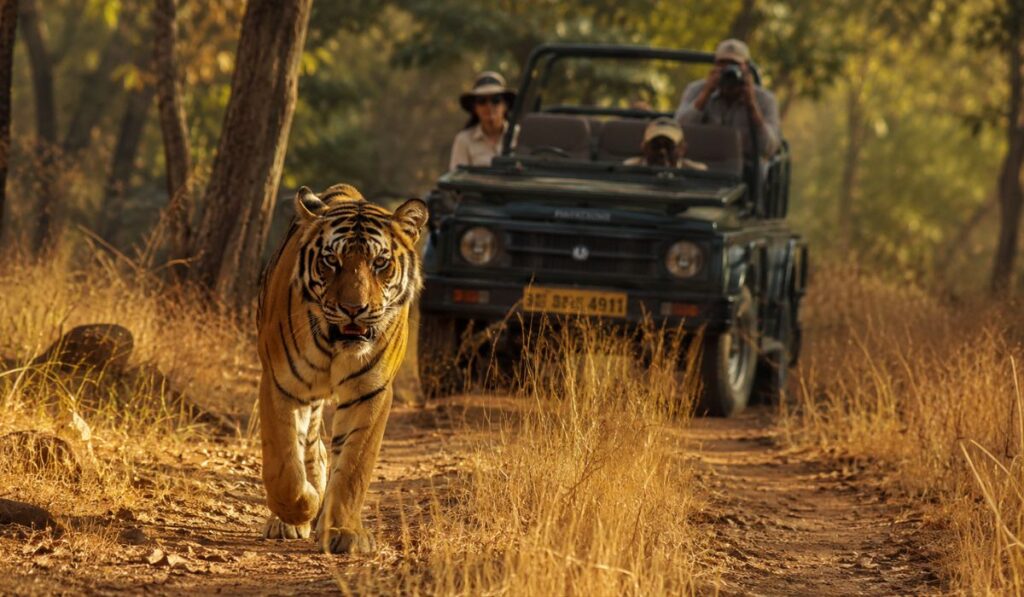
Tiger Safaris That Rival Africa
The question is not whether India has great wildlife. It is whether the rest of the world has simply failed to pay attention.
The Bengal tiger is one of the most magnificent animals alive — striped, solitary, and enormous in the way that makes you forget, momentarily, to breathe. India is home to more wild tigers than any country on earth, and the best reserves offer encounters that veteran Africa safari-goers describe as more intimate, more surprising, more raw.
Ranthambore in Rajasthan is perhaps the most famous — an ancient fort rising from the jungle, tigers known by name lounging near the lakes, leopards slipping through the underbrush. Bandhavgarh in Madhya Pradesh has one of the densest tiger populations in the country; mornings here have a quality of anticipation that is almost unbearable in the best sense. Kanha, the reserve that partly inspired Rudyard Kipling’s The Jungle Book, offers a landscape so pristine it feels untouched by the twentieth century.
The luxury tiger safari India experience has evolved significantly. The best lodges in these reserves — think tented suites with private plunge pools, bespoke game-drive menus, resident naturalists — rival the finest camps in the Serengeti. But the price point remains considerably lower, and the sense of discovery remains very much intact.
Wellness, Spas, and Slow Luxury
Long before the wellness industry became a global obsession, India invented it.
Ayurveda — the 5,000-year-old science of life, balance, and healing through food, herbs, massage, and breath — is not a spa treatment here. It is a philosophy that shapes how people eat, how they sleep, how they understand disease and vitality. Experiencing it in its homeland, under the guidance of practitioners whose families have studied it for generations, is fundamentally different from the diluted version that arrived in American wellness resorts.
Kerala, the lush coastal state in India’s south, is the heartland of authentic Ayurvedic practice. The luxury wellness resorts here — set amid rice paddies and coconut groves, with the Arabian Sea glinting in the distance — offer programs that range from weekend retreats to 21-day classical treatments. Yoga, too, reaches a different depth in India. Practiced in the foothills of Rishikesh, at sunrise, overlooking the Ganges, it is not exercise. It is something else entirely.
For travelers whose definition of luxury includes restoration — real, cellular-level rest — India may be the most powerful destination on earth.
One Country, Many Luxury Vacations
The remarkable thing about India is that it is not one destination. It is many countries layered within a single border.
The desert forts and camel dunes of Rajasthan share almost nothing culturally, climatically, or architecturally with the backwater canals of Kerala, where you drift through villages of coconut palms on a hand-carved rice barge, eating prawn curry for lunch and watching kingfishers skim the waterline. Neither bears any resemblance to the high-altitude silence of Ladakh, where Buddhist monasteries cling to cliffs above landscapes that look extraterrestrial. And the Taj Mahal belongs to a cultural tradition entirely distinct from the Dravidian temples of Tamil Nadu, whose towers rise in vertical explosions of carved stone and painted deities.
What this means, practically, for the luxury traveler: you could return to India five times and never repeat an experience. Every corner of the country offers its own cuisine, its own architecture, its own textile tradition, its own version of beauty.
What Surprises Most American Travelers
The first thing most Americans report, returning from India, is the hospitality.
Not the monuments — though those, too. The hospitality. The instinctive, uncomplicated warmth that characterizes interactions across the country, from the small-town guesthouse to the seven-star hotel. The word atithi — guest — occupies a sacred position in Indian culture. A guest is not a customer. A guest is, in the traditional sense, a kind of blessing.
American travelers who arrive expecting chaos and difficulty often discover that a well-planned private India tour moves with a fluid elegance that is possible precisely because of how deeply service is woven into the culture. The guides are extraordinary — not just informative but genuinely passionate, the kind of people who will change the way you think about history.
The diversity surprises, too. The food, already an obsession in the United States, is a revelation in its homeland — not one cuisine but dozens, each region as distinct as a different country. The languages, the religions, the architecture, the music: all of it layered, alive, and thrillingly complex.
Why Luxury India Travel Belongs on Every Bucket List
There is a particular kind of travel that changes something in you — not just the way you see the world, but the way you understand your place in it. India does this.
It humbles you with its antiquity. It delights you with its chaos and its color. It moves you with its beauty. And it treats you, from the moment you arrive, with a graciousness that makes even the most jaded traveler feel seen.
Luxury India travel is not about insulating yourself from the country in a bubble of comfort — though the comfort, when you want it, is genuinely world-class. It is about being held gently enough by excellent logistics and exceptional hospitality that you can actually receive what India has to offer: all of it, unmediated, extraordinary.
There will come a moment — standing before the Taj Mahal at first light, or watching a tiger materialize between the trees at Ranthambore, or floating down a backwater canal at dusk — when you will understand, with sudden clarity, why people who have been to India speak about it the way they do.
You will already be planning your return.
Frequently Asked Questions
Is India a good destination for luxury travel?
Absolutely. India has a world-class luxury infrastructure that includes palace hotels, heritage resorts, private wildlife lodges, and deeply personalized service traditions that date back centuries. Cities like Udaipur, Jaipur, and Delhi rival any European capital for luxury accommodation, and the country’s cultural depth, biodiversity, and culinary richness make every experience genuinely distinctive. For travelers seeking something beyond the predictable European circuit, India is arguably the most rewarding luxury destination in the world.
How much does a luxury trip to India cost?
A well-planned luxury trip to India typically ranges from $400 to $900 per person per night, all-inclusive of palace hotel stays, private guides, luxury vehicles, and fine dining. A 10-day luxury itinerary for two can often be accomplished for $8,000–$15,000, which compares extremely favorably with comparable luxury experiences in Western Europe, the Maldives, or safari destinations in Africa. India’s luxury tier delivers exceptional value — the quality of service, accommodation, and experience consistently exceeds what comparable spending would purchase almost anywhere else.
What is included in a Luxury Golden Triangle Tour?
A Luxury Golden Triangle Tour covers India’s three most iconic destinations — Delhi, Agra, and Jaipur — and typically includes private air-conditioned vehicle transfers, expert private guides at each site, stays in heritage palace hotels or five-star luxury properties, select fine dining experiences, and seamless itinerary management. Premium versions may include exclusive early-access visits to the Taj Mahal, private museum tours, cooking classes with master chefs, and curated cultural experiences such as block-printing workshops or classical music performances. The route is ideal for first-time visitors to India.
Are palace hotels in India worth it?
Without question. Rajasthan’s palace hotels are among the most singular accommodation experiences available anywhere in the world. These are genuine royal residences — ancestral forts, maharajas’ summer retreats, and heritage havelis — that have been converted into luxury hotels without sacrificing their historical character. Staying in them is not simply about comfort; it is about inhabiting a particular chapter of history. The combination of extraordinary architecture, royal-standard service, and the emotional resonance of sleeping inside a living monument makes these properties worth every penny.
When is the best time to visit India for luxury travel?
The optimal window for most of India’s luxury destinations — including Rajasthan, the Golden Triangle, and wildlife reserves — is October through March, when temperatures are comfortable, skies are clear, and the landscape is at its most accessible. November through February is the peak luxury travel season, with daytime temperatures typically ranging from 60°F to 80°F. For tiger safaris, March and April can offer exceptional sightings as animals congregate around water sources before the monsoon. Kerala’s best weather runs from September through March. The summer months (April–June) bring intense heat to the north, and the monsoon season (July–September) is best suited for lush landscape photography and Ayurvedic retreats.