What $10,000 Buys You in India: A Luxury Journey Through Palaces, Tigers & the Taj Mahal
There is a persistent assumption that India belongs on the backpacker circuit — that it is a place of budget guesthouses, crowded trains, and sensory overload best navigated on a shoestring. That assumption is spectacularly wrong.
India has quietly become one of the world’s most compelling luxury destinations, and discerning travelers from the United States, United Kingdom, Canada, and Australia are increasingly discovering what those in the know have long understood: a generous budget in India does not simply buy you comfort — it buys you access to experiences that no amount of money can replicate anywhere else on earth.
A $10,000 travel budget that would cover a modest week in Paris, a pleasant but unremarkable tour of Tuscany, or a single-lodge safari in Kenya will, in India, fund ten to fourteen days of genuine five-star travel. That means palace suites with butler service, private sunrise access to the Taj Mahal, naturalist-led tiger safaris in luxury wildlife lodges, chauffeur-driven journeys across Rajasthan, and chef-curated dinners beneath the stars. It means traveling with a private guide who has spent thirty years studying Mughal architecture. It means Ayurvedic spa treatments in the marble courtyards of a former maharaja’s residence.
This is what $10,000 actually looks like when you spend it wisely in India.
Is $10,000 Considered Luxury Travel in India?
In Western Europe, $10,000 covers approximately seven to eight nights in a genuine five-star hotel, a handful of fine dining meals, and economy or premium economy flights. The math is humbling. In Paris, a suite at Le Bristol costs upwards of $1,500 per night. A private day tour of Rome’s Vatican with an expert guide runs $600. Dinner at a Michelin-starred restaurant in London can easily reach $400 per person with wine.
India recalibrates everything.
At India’s finest palace hotels — the Umaid Bhawan Palace in Jodhpur, Samode Palace outside Jaipur, or the Taj Lake Palace in Udaipur — a luxury room costs between $350 and $700 per night, while suites at comparable properties run $800 to $1,500. These are not merely expensive hotels. They are living monuments: former royal residences converted into hospitality experiences where the ratio of staff to guests routinely exceeds five to one.
A private, expert-led full-day tour across India’s major sites typically costs $150 to $300 — for a guide whose knowledge is encyclopedic and whose access sometimes extends to areas closed to the general public. A five-course dinner at one of Mumbai’s most acclaimed restaurants rarely exceeds $150 per person with wine pairings.
For a couple traveling together, $10,000 — after international flights, which typically run $1,500 to $2,500 per person from the US or UK — leaves a realistic on-the-ground budget of $5,000 to $7,000. That figure, stretched across twelve days in India, funds a standard of travel that would cost three times as much in France or Italy.
The value is not a compromise. India’s luxury infrastructure has matured significantly. The Taj Hotels group, Oberoi Hotels & Resorts, and Aman have raised service standards that compete directly with the world’s best. The difference is that here, the architecture has four hundred years of history behind it, and the cultural depth is inexhaustible.
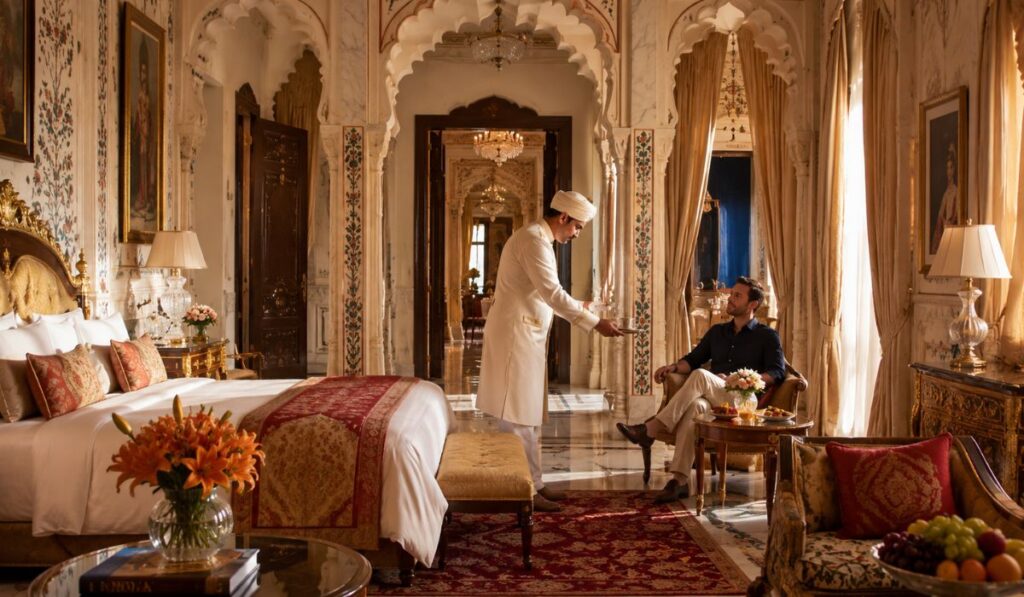
Living Like Royalty in India's Palace Hotels
The concept of royal hospitality — atithi devo bhava, meaning “the guest is God” — is not a marketing slogan in India. It is a cultural inheritance that shapes the way India’s finest properties approach service, and it produces an experience that European luxury hotels, however excellent, simply cannot replicate.
India’s palace hotel circuit is unlike anything else in the world. Rajasthan alone contains dozens of former royal residences that have been converted into exceptional hotels, each carrying the specific character of the dynasty that built it. The Luxury Rajasthan Tour experience centers on these properties, using them not just as accommodation but as immersive introductions to India’s royal past.
Umaid Bhawan Palace, Jodhpur — still partially a royal residence — features 64 suites spread across a 1943 Art Deco building that required 3,000 workers fifteen years to complete. Guests swim in a marble pool that predates the hotel’s conversion, eat beneath original painted ceilings, and sleep in beds that have hosted actual royalty.
Samode Palace, Jaipur is smaller and more intimate — a sixteenth-century fortress where the painted sheesh mahal (mirror palace) chambers are so intricate that natural candlelight fractures across thousands of embedded glass tiles. The experience of dining in such a space, with a menu designed around the royal cuisine of the region, is not theatrical. It is genuinely moving.
Taj Lake Palace, Udaipur occupies an entire island on Lake Pichola and functions as the most romantic hotel in India by common agreement among people who have stayed in a great many hotels. Arrival by boat at dusk, with the Aravalli Hills fading behind the marble columns of the palace, is the kind of moment you will reconstruct accurately for the rest of your life.
Butler service at these properties is attentive without being intrusive. Staff remember preferences from the first day and apply them quietly thereafter. Turndown involves rose petals. Morning coffee arrives exactly when requested. These are not gestures — they are the expression of a hospitality culture in which guests are genuinely honoured.
Experiencing the Taj Mahal in Ultimate Comfort
Every year, seven to eight million people visit the Taj Mahal. On a standard morning, the site fills quickly: tour buses arrive from Agra and Delhi before 8am, and by mid-morning the forecourt is dense with visitors. This is not how wealthy travelers should experience the world’s most recognized building.
A private Luxury Taj Mahal Tour is structured differently, beginning with sunrise access — arriving at the eastern gate before the main crowds, often accompanied by a scholar-guide whose specialty is Mughal architecture and the specific history of Shah Jahan’s commission of the monument as a mausoleum for his wife Mumtaz Mahal.
At dawn, with the light shifting from gray to gold to white across the marble surface of the dome, the Taj Mahal reveals qualities that afternoon photographs cannot capture: the way the inlaid pietra dura floral work — semi-precious stones set directly into marble — catches the early light; the extraordinary symmetry that becomes apparent only when you stand at the far end of the reflecting pool and understand that the architects planned this precise perspective in the seventeenth century.
A good private guide will take you inside the mausoleum during the quietest period, explain the calligraphy carved into the gateway arches (Quranic verses chosen with precise intentionality), and position you in the gardens in ways that produce photographs entirely different from the standard tourist images.
Luxury transportation from Delhi to Agra on the Luxury Golden Triangle Tour — covering Delhi, Agra, and Jaipur — is typically provided by a private air-conditioned vehicle with a professional driver, though the Gatimaan Express, India’s fastest train, offers a genuinely enjoyable two-hour journey that many travelers prefer for the experience. A full-day private visit to the Taj complex, including Agra Fort and Itmad-ud-Daulah, costs approximately $300 to $400 for the guide, vehicle, and all entry fees — a remarkable figure for what is, objectively, one of the greatest cultural sites in the world.

Luxury Tiger Safaris That Rival Africa
The African safari sits at the top of most luxury bucket lists, and rightly so. But India’s tiger reserves — less discussed, significantly less crowded, and in several respects more dramatically beautiful — offer a wildlife experience that stands entirely on its own terms.
India is the only country on earth where you can observe Bengal tigers in reasonable density in their natural habitat. The country’s tiger population, which fell to approximately 1,400 animals in 2006, has recovered to over 3,000 today — a conservation story with very few parallels in modern wildlife management.
Ranthambore National Park in Rajasthan is the most accessible tiger reserve from the Golden Triangle circuit and has produced some of the most famous wildlife photography in Asia. The ruins of Ranthambore Fort — a tenth-century structure that rises dramatically above the forest canopy — provide a backdrop that distinguishes the Indian safari experience from anything available in Africa.
Bandhavgarh National Park in Madhya Pradesh has one of the highest tiger densities of any reserve in India. Sightings here are more consistent, and the park’s terrain — meadows, bamboo groves, and sal forest cut through with streams — makes for an aesthetically varied landscape.
Luxury tiger safari lodges in India have improved enormously over the past decade. Properties like Mahua Kothi (Bandhavgarh) and Sher Bagh (Ranthambore), both operated by Taj Safaris, offer accommodation that rivals East African camps: private tents with stone bathrooms, curated dining, naturalist-led morning and evening drives in dedicated jeeps, and evening conversations around fire pits with guides who have spent decades studying individual animals.
Daily safari rates at premium lodges run $400 to $700 per person, including accommodation, meals, and game drives. A four-night Luxury Tiger Safari India stay at a top-tier property costs approximately $2,000 to $3,000 per couple — comparable to mid-range African safari pricing, but with the added context of India’s conservation narrative and the dramatic historical ruins that punctuate many of the reserves.
The differences from Africa are worth naming honestly. African savannahs provide longer sightlines and often more concentrated wildlife spectacle. India’s forests offer more intimate encounters, smaller jeeps, and a different kind of tension — tracking a tiger through dense vegetation requires patience, and the payoff, when it arrives, is correspondingly intense.
Traveling Across India in Style
One of the practical differences between standard and luxury travel in India is movement. India is large, its infrastructure varies considerably by region, and how you travel between destinations shapes your experience as much as where you stay.
A Private India Tour with dedicated transport eliminates the variables that make independent travel in India tiring. A professional driver in a well-maintained air-conditioned vehicle — typically a Toyota Innova or similar — provides the flexibility to stop at a rural market, pull over for a roadside chai, or take an alternative route to avoid traffic, without the anxiety of navigating unfamiliar roads in a country where traffic patterns require considerable local knowledge.
For longer distances, premium domestic aviation is the sensible solution. IndiGo, Air India, and Vistara (now merged with Air India) connect major cities, with business class fares on domestic routes running $150 to $300 — comfortable and reliable.
The Maharajas’ Express, India’s most celebrated luxury train, operates circuits through Rajasthan and Central India between October and April. Aboard, guests travel in wood-paneled cabins with en-suite bathrooms, eat in dining cars serving multi-course meals, and disembark at heritage sites via private excursion vehicles. A seven-night journey on the Maharajas’ Express costs from $5,000 per person — a premium experience that some travelers choose as their entire India itinerary rather than a single component of it.
For those who prefer not to dedicate their budget to the train, the Eastern & Oriental Express occasionally runs Indian circuits, and several state tourism boards operate their own heritage railway journeys at more accessible price points.
What affluent travelers consistently report appreciating most about private transport in India is the conversation. A driver who has worked the Rajasthan circuit for twenty years becomes, over three days of shared roads, an informal cultural interpreter. These unscripted interactions — stopping to watch a wedding procession cross a rural road, being invited to photograph a camel fair in a village market — are not available on group tours.
India's Luxury Culinary Scene
Indian food abroad bears almost no relationship to the regional cuisines of India itself. This is worth stating clearly, because most international travelers arrive with expectations shaped by restaurant versions of butter chicken and naan, and then spend their first meal in Rajasthan discovering that this country’s food is as varied, historically layered, and technically accomplished as any culinary tradition on earth.
Palace dining is the natural entry point. The Oberoi Amarvilas in Agra serves a tasting menu of Mughal court cuisine — dishes like murgh mussallam (whole roasted chicken with aromatic spice paste) and shahi korma (lamb in a saffron and almond sauce) that are reconstructed from seventeenth-century royal recipes. Context transforms the meal: eating dishes that were once prepared for emperors, in a building visible from the Taj Mahal, is not merely dinner.
In Rajasthan, the laal maas (fiery red mutton curry cooked with Mathania chilies) and dal baati churma (wheat dumplings baked over charcoal, served with lentils and sweetened flour) represent a cuisine shaped by arid landscapes and royal hunting traditions. At properties like Sujan Sher Bagh in Ranthambore, meals are served outdoors by lantern light, with dishes drawn from the same regional ingredients that have fed this part of India for centuries.
Mumbai’s fine dining scene has matured considerably and now includes restaurants of genuine international standing. Masque, in the city’s Mahalaxmi district, operates a tasting menu that explores Indian ingredients through a modern culinary lens — wild ingredients foraged from across India’s diverse ecosystems, presented with a technical precision that makes direct comparison with Europe’s best restaurants entirely reasonable.
A private cooking class with a senior chef at a heritage hotel — learning to prepare regional dishes from scratch, visiting the spice market that supplies the kitchen — costs $100 to $200 and provides a framework for understanding Indian cuisine that survives long after the trip ends.
Wellness, Spa, and Rejuvenation
India is the country of origin for both Ayurveda and yoga — two systems of physical and mental practice that have been absorbed by wellness culture globally but exist in India in their original, unfiltered forms. The difference between a yoga class at a Western spa hotel and a morning practice led by a teacher trained in the Krishnamacharya tradition in Mysore is the difference between a photograph and the place it depicts.
Luxury wellness retreats in India have grown significantly in both number and quality over the past decade. Ananda in the Himalayas, above the Ganges town of Rishikesh, is frequently cited among the finest wellness retreats in the world. Set within a 100-acre maharaja’s estate in the Himalayan foothills, it offers residential Ayurvedic programs of five to twenty-one days, combining traditional pulse diagnosis, individualized treatment plans, therapeutic massage, and yoga with genuine luxury accommodation and exceptional food. A five-day program runs approximately $3,000 to $5,000 per person, all-inclusive.
In Kerala, the Ayurvedic heartland of India, properties like Somatheeram and CGH Earth’s Kalari Rasayana have been offering medically supervised Ayurvedic treatments for decades. These are not spa weekends. They are immersive health interventions that practitioners take seriously, and that guests — particularly those dealing with chronic stress, sleep disorders, or inflammation — report finding genuinely transformative.
At most luxury heritage hotels across Rajasthan, spa menus combine Ayurvedic treatments with contemporary wellness offerings. A two-hour Abhyanga massage (warm oil applied in long rhythmic strokes by two therapists working in synchrony) costs $80 to $150 at a palace hotel spa — a fraction of what equivalent treatments cost at European or American luxury hotels.
The broader wellness tourism market in India is growing at approximately 12% annually, driven by international visitors who understand that the country’s centuries-long tradition of holistic medicine offers something that cannot be adequately replicated by Western spas applying Eastern vocabulary.
Sample Luxury Budget Breakdown
The following breakdown illustrates how a $10,000 budget might be allocated for two travelers over twelve days, after international flights (estimated separately at $1,500–$2,500 per person).
Category | Details | Estimated Cost (for 2) |
Accommodation | 8 nights palace/heritage hotels + 4 nights luxury safari lodge | $4,000–$5,500 |
Private Transport | Chauffeur-driven vehicle for ground transfers across Rajasthan and Agra | $600–$900 |
Domestic Flights | 2 flights (e.g., Delhi–Jaipur, Jaipur–Ranthambore region) | $300–$500 |
Safari Experiences | Game drives, naturalist guides, park fees (4 nights) | $800–$1,200 |
Private Guides | Expert cultural/heritage guides across Delhi, Agra, Jaipur | $500–$700 |
Dining | Mix of palace restaurants, fine dining, and local culinary experiences | $600–$900 |
Experiences & Entry | Taj Mahal sunrise, cooking class, spa treatments, cultural excursions | $500–$800 |
Contingency & Tips | Gratuities, incidentals, shopping | $300–$500 |
Total (on-ground) | $7,600–$10,000 |
This budget comfortably accommodates two travelers at a genuine luxury standard. Solo travelers can reduce accommodation costs by around 30%, while families or groups of four benefit from per-person efficiency gains, particularly in private transport and guiding.
Why Luxury Travel in India Feels Different
There is a quality to high-end travel in India that is difficult to articulate without sounding vague, but it comes down to this: the experience is not performed for you. It is real.
At a palace hotel in Rajasthan, the family whose ancestors built the building often still live in the adjacent wing. The guide who walks you through a Mughal garden is not reciting information — they are sharing a relationship with a place they have spent decades understanding. The chef preparing royal Rajasthani cuisine for your dinner learned those recipes from a tradition that has been continuous for generations. The cultural depth is not a backdrop. It participates.
Luxury travel in Europe is often excellent but fundamentally static: you visit things that exist to be visited. In India, heritage is still inhabited. History is still in use. A fort is not a museum — it is a place where people still conduct festivals, worship, and gather. This creates a form of immersion that no other luxury destination quite matches.
The personal attention at India’s finest properties is also qualitatively different from European luxury service. It is warmer, more genuinely interested in the guest as a person, and more culturally generous — guides, drivers, and hotel staff consistently go beyond professional obligation in ways that leave travelers genuinely surprised. This is not a cultural performance. It is the expression of a hospitality ethic that is deeply embedded.
Exclusivity in India takes an unusual form. Rather than the exclusivity of restriction — access denied to those without sufficient funds — India offers the exclusivity of depth. Anyone can visit the Taj Mahal. Only a small number of visitors will stand inside it at dawn with a scholar who can read the Arabic calligraphy and explain what Shah Jahan chose to carve above the main arch and why that choice reveals something about his grief.
Who Should Consider This Type of Journey?
Couples and honeymooners find India consistently exceeds expectations. The combination of romantic architecture — lake palaces, candlelit courtyards, rooftop dinners above illuminated forts — with genuine cultural substance makes it a more meaningful honeymoon destination than many more conventionally romantic alternatives.
Families with older children (roughly twelve and above) benefit enormously from the range of experiences available: wildlife safaris generate excitement across generations, palace hotels create a context for history that no classroom can replicate, and the sheer visual variety of India holds attention across different temperaments.
Retirees and older travelers represent the fastest-growing segment of luxury India tourism, drawn by the depth of cultural and historical content, the quality of spa and wellness offerings, and the genuine comfort available at top-tier properties. Private transport and tailored pacing make the journey manageable without sacrificing ambition.
Luxury adventure travelers who have covered the established safari circuit in Africa, the temples of Southeast Asia, and the ruins of Latin America increasingly find that India offers a density and variety of high-quality experiences that sustains extended itineraries without repetition.
The Bespoke India Travel approach — designing a journey around specific interests rather than following a fixed circuit — suits all these profiles, because India is large enough and varied enough to accommodate almost any combination of priorities.
Frequently Asked Questions
Is India a true luxury travel destination?
Yes, by any meaningful definition. India has a robust infrastructure of five-star palace hotels, luxury safari lodges, private guiding, and premium transportation services. The Taj Hotels, Oberoi, and Aman groups operate properties in India that compare directly with their offerings in Europe and Southeast Asia.
How much does a luxury India trip cost per person?
For a twelve-day itinerary covering the Golden Triangle and a tiger safari at a genuine luxury standard, expect to budget $4,000 to $6,000 per person on the ground, excluding international flights. A couple sharing a room and transport achieves better per-person value than solo travelers.
What is the best time to visit India for a luxury trip?
October through March is the optimal window for most of northern and central India. Temperatures are comfortable, wildlife visibility in the reserves is highest (particularly November through February), and the golden light of the dry season produces extraordinary photography conditions.
What are the best palace hotels in India?
The Umaid Bhawan Palace (Jodhpur), Taj Lake Palace (Udaipur), Samode Palace (Jaipur), and Oberoi Amarvilas (Agra) consistently rank among the finest. The Leela Palace in Udaipur and Raas Devigarh near Nathdwara offer more intimate alternatives with exceptional design.
How does a luxury tiger safari in India compare with Africa?
African safaris generally offer greater wildlife density and diversity. India’s tiger reserves offer more intimate encounters, dramatically beautiful landscapes that include historical ruins, and a compelling conservation narrative. Many experienced wildlife travelers consider Bandhavgarh or Ranthambore an essential complement to African safari experience, not a substitute for it.
Is India safe for international luxury travelers?
Yes. India’s established tourism infrastructure — particularly in Rajasthan, Agra, and the major tiger reserves — is well-organized for international visitors. Private tour operators provide professional drivers, vetted guides, and 24-hour support. Standard urban precautions apply in cities as they would globally.
What does a private India tour include that a group tour does not?
Private tours offer flexible pacing, the ability to linger at sites that engage you and move quickly through those that don’t, access to experiences that groups cannot accommodate (private cooking classes, off-hours site visits, specialist guides), and the freedom to adjust the itinerary based on preference or opportunity.
How far in advance should a luxury India trip be booked?
For travel during peak season (October through February), six to nine months in advance is advisable for the best palace hotel suites and safari lodge availability. Shoulder season (March to April, September) allows more flexibility.
Are there luxury wellness experiences worth including in an India itinerary?
Absolutely. Even travelers not specifically pursuing a wellness retreat benefit from incorporating one or two Ayurvedic treatments — an Abhyanga massage, a traditional shirodhara (warm oil poured over the forehead) — during their stay at palace hotels. For those with a specific interest in wellness, Ananda in the Himalayas warrants a dedicated itinerary rather than an add-on.
What makes the Luxury Golden Triangle Tour distinctive at the luxury level?
The Delhi–Agra–Jaipur circuit, the most traveled in India, rewards luxury investment through the quality of accommodation, guiding, and access. At the budget level, this route can feel crowded and rushed. With private guiding, palace accommodation, and careful timing — particularly the sunrise Taj Mahal experience — it reveals layers of Mughal and Rajput history that the standard tour entirely misses.
A Note From the Field
After personally visiting luxury properties across Rajasthan, Agra, and Madhya Pradesh — staying in palace suites, riding in private jeeps through Ranthambore at dawn, and standing inside the Taj Mahal before the first tour bus arrived — one thing becomes clear: India delivers a level of heritage access and personal attention that almost no other destination can match at this price point.
The surprise is not that India is luxurious. The surprise is how effortlessly it is. A butler who has worked at the same palace hotel for twenty-two years knows things about that building — and about hospitality — that no amount of five-star training can produce. A guide who grew up two kilometers from Fatehpur Sikri does not recite history. He inhabits it.
Travelers who arrive expecting to tolerate India in exchange for its monuments leave having found something they did not anticipate: a country that looks after you with a warmth and sincerity that stays with you long after the photographs have been filed and the jet lag has cleared.
— Lewis & Clark Tours Editorial, based on direct experience across India’s luxury travel circuit
Conclusion
India is not a destination you approach cautiously, hoping it will meet expectations. It is a place that routinely exceeds them, particularly for travelers who have invested in the infrastructure to experience it properly.
A $10,000 budget does not merely buy comfort in India — it buys access to a civilization’s accumulated beauty, deployed through hospitality traditions that have been refined over centuries. The ratio of investment to experience is genuinely unusual, and it is unlikely to remain this favorable as India’s luxury profile continues to rise internationally.
But there is something beyond the value calculation that matters more. India is a country where travel is still transformative in the original sense of the word — where you genuinely encounter a way of seeing the world that is different from your own, and where that encounter happens not at a cultural remove but in direct, unmediated contact. The guide who translates an Urdu inscription on a Mughal cenotaph, the desert night sky visible from the ramparts of a fort that was old before Shakespeare was born, the moment a tiger walks across a forest track forty feet in front of a stationary jeep and pauses, indifferent, before disappearing into the trees: these are the things that a well-planned Luxury India Tour actually delivers.
The palaces are extraordinary. The Taj Mahal is, after everything you have seen and heard, still extraordinary. The tigers are extraordinary. But the real luxury India offers is something subtler — the sense of being in a place that has been accumulating human meaning for thousands of years, and feeling, briefly and improbably, that some of it has passed through you.
Ready to Plan Your Luxury India Journey?
Considering a luxury India journey? Start with a private consultation to design a bespoke itinerary built around your specific interests, travel dates, and priorities — whether that means securing the finest palace suites in Rajasthan, timing your safari for peak tiger visibility, or combining a Golden Triangle circuit with a Himalayan wellness retreat.
Request Your Private Consultation → Lewis & Clark Tours
Our India specialists have first-hand experience across the properties, reserves, and routes described in this article. There are no pre-packaged group tours. Every itinerary is built from scratch, for you, around what you actually want from this journey.