What It Feels Like to Wake Up in a 300-Year-Old Palace in Rajasthan
The first thing you notice is the silence. Not the hollow, anonymous silence of a five-star hotel room with its blackout curtains and climate-controlled air. This is something older, denser — a silence that has been accumulating for three centuries, layer upon layer, like dust on gilded frames and monsoon memories soaked into sandstone walls. You lie still beneath a canopy of hand-embroidered silk, and for a long, suspended moment, you genuinely cannot remember which century you belong to. This is what it means to wake up inside a palace in Rajasthan.Whether you are dreaming of exploring colourful streets, relaxing in serene countryside landscape or experiencing in Indian deep is spiritual energy, we are here to bring your vision to life let us guide you through luxury India travels like never before.
Before the World Begins
Dawn arrives slowly here, as though it, too, is reluctant to disturb something sacred.
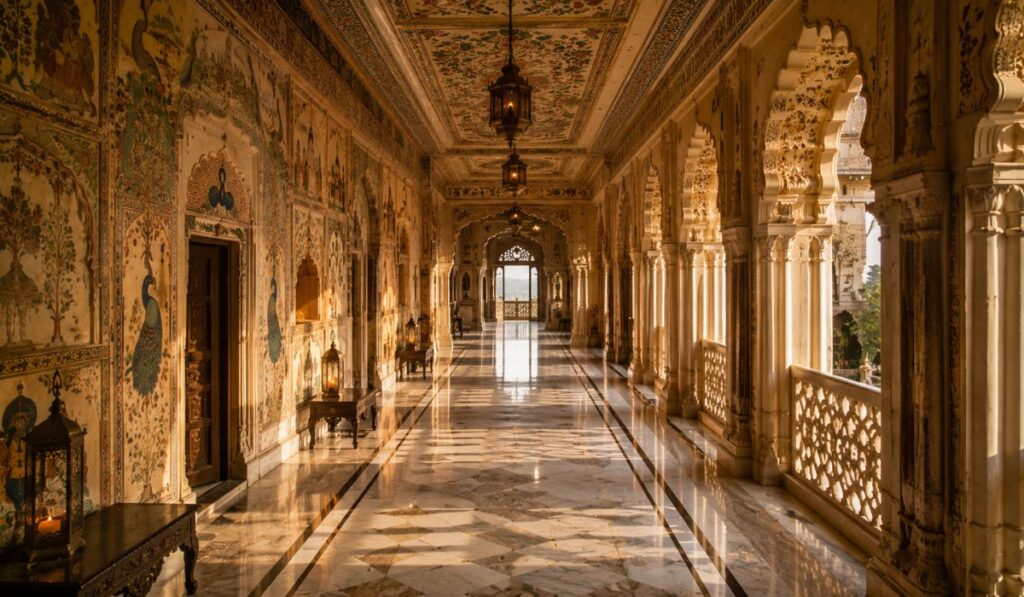
Through the latticed jharokha window — those intricate stone screens that Rajput queens once peered through to observe the world below — the light comes in not as a flood but as a whisper. It falls in geometric patterns across the marble floor, pale amber and rose-gold, shifting almost imperceptibly as the sun lifts itself over the Aravalli hills. The air carries the faint sweetness of jasmine from the courtyard garden, threaded through with something older and earthier: warm sandstone, incense from the morning prayers of the household staff, the distant memory of sandalwood.
You reach for your tea — already placed silently on the inlaid side table while you slept, because in a palace of this calibre, anticipation is a form of art — and you sit at the edge of the carved charpoy bed and simply breathe. This is the luxury that no amount of thread count or Michelin stars can manufacture: the feeling of being held, gently and without effort, inside a living piece of history.
This is not a hotel in any conventional sense. This is a Royal Palace Stay, and the distinction matters enormously.
The Architecture of Dreaming
The palace itself demands to be read slowly, like a poem written in stone.
Built in the early eighteenth century by a Rajput nobleman whose name is still spoken with quiet reverence in the surrounding village, the structure is a masterwork of rajputana craftsmanship. The corridors are long and cool, their walls dressed in intricate fresco paintings — processional elephants, celestial musicians, scenes from the Ramayana rendered in pigments made from crushed lapis lazuli and powdered gold. Doorways are crowned with carved peacocks, their tails forever mid-display, frozen in pride. Every archway is a frame; every courtyard, a stage.
To stay here — to choose a Heritage Luxury Experience over the polished anonymity of a modern resort — is to understand that architecture can have a soul. The stone remembers warmth. The walls retain the echo of old celebrations, old losses, old prayers. You move through these spaces and you feel, without being able to explain it rationally, that you are not simply a guest. You are a temporary inhabitant of something much larger than yourself.
The private plunge pool in your suite courtyard is fed by an ancient baoli water system, cleverly restored. The copper-fitted bathroom is all hand-hammered surfaces and antique mirrors with their beautiful imperfections. Your dressing table holds silver-lidded jars of locally-sourced oils — rose, vetiver, kesar — arranged like offerings. These are not design choices made in a corporate boardroom. They are continuations of a tradition.

The Sound of Another Era
Close your eyes in the late morning and listen.
Somewhere in the distance, a peacock calls — that operatic, mournful cry that carries across the dry Rajasthani air like a question with no answer. Beneath it, the measured rhythm of a tabla being tuned in the music courtyard, where the palace’s resident musician practices the same morning ragas that were performed for the original residents two hundred years ago. Occasionally, the soft padding of footsteps on cool stone as a staff member — dressed in the palace’s livery of ivory and gold — moves through the corridors with unhurried purpose.
There are no announcement systems. No piped corporate music. No sound of elevator doors sliding open. The palace communicates in a different register entirely, and once you have attuned to it, the silence of ordinary luxury hotels will feel, ever after, slightly hollow.
This is the particular gift of a Luxury Rajasthan Tour that places heritage at its heart rather than using it merely as backdrop: you don’t visit history. You inhabit it, briefly and beautifully.
The Table of Kings
Evenings in a Rajasthan palace are theatre of the most exquisite kind.
As the sun descends and the sandstone walls shift from amber to deep ochre to a colour that has no name in any modern paint catalogue, the courtyards are prepared for dinner with the kind of care that borders on devotion. Brass oil lamps are lit by hand, their flames steady in the windless dusk. Rose petals — fresh from the palace garden — are scattered across white-linen tables set with silverware that has been in the family’s possession for generations.
You are seated beneath open sky, surrounded by the carved battlements of the palace walls, with the evening star appearing directly overhead as though placed there specifically for your pleasure.
The food arrives in procession. Not a tasting menu engineered for novelty, but a royal thali assembled from recipes that have been passed down through the palace kitchen for as long as the building has stood: laal maas slow-cooked with hand-ground spices in a clay pot sealed with dough; ker sangri, the wild desert berry preparation that sustained Rajput armies on long campaigns; a dal baati churma so precise in its sweetness and smoke that it feels less like a dish and more like an argument for the existence of civilisation. The kheer that arrives at the end — cardamom-laced, topped with edible silver leaf — is nothing short of a quiet philosophical statement.
This is Luxury India Travel at its most emotionally resonant: not consumption, but communion.
The Difference Between New Luxury and Old Luxury
Let us speak plainly for a moment, because the distinction deserves to be made.
The finest modern hotels are extraordinary achievements of engineering, service, and design. Their lobbies are soaring. Their spas are transformative. Their restaurants carry the ambitions of the world’s great culinary traditions. No serious traveller should dismiss what they offer.
But they are, at their core, perfect stages. Beautifully constructed, brilliantly lit — and empty of memory.
Palace Hotels in Rajasthan offer something that cannot be built, only inherited: the weight of continuous human habitation. The knowledge that in the room where you now sleep, someone once wept at a window watching a beloved horse return riderless from battle. That in the courtyard where you now sip your evening gin, a Maharaja once received a British envoy with calculated ceremonial splendour. That the garden where you walk in the blue hour of dawn was designed by a woman whose name has been lost to history but whose aesthetic intelligence speaks, still, through the placement of every tree and fountain.
This is the irreproducible luxury of deep time. And it is available, for those who seek it through carefully curated Private India Tours, in extraordinary measure.
Slow Travel as Its Own Reward
There is a concept increasingly understood by the world’s most discerning travellers: that the highest form of luxury is not acceleration but its opposite.
To spend three nights in a single palace — to watch the same courtyard transform from the silver-grey of early morning to the gold of afternoon to the indigo of night, to learn the name of the gardener who tends the jasmine, to hear the same peacock call from the same tree at the same hour each dawn — is to receive something that a carefully optimised multi-city itinerary can never offer: the luxury of depth.
Rajasthan Luxury Holidays designed around this philosophy — slow, immersive, intimate — are increasingly the choice of travellers who have seen the world’s great sites and now wish to feel them. They are for those who understand that the souvenir worth carrying home is not an object purchased in a market but a change in the quality of one’s own attention.
The palace teaches you, gradually and without insistence, to look more carefully. To notice the way light moves. To appreciate silence as a form of conversation. To understand that three centuries of human life, love, grief, and celebration have seeped into these stones, and that you — for these few extraordinary days — are part of the story now.
The Morning You Will Never Forget
On your last morning, you wake earlier than the palace itself.
You wrap a pashmina around your shoulders and walk to the rooftop terrace in the pre-dawn dark, and you stand there as Rajasthan assembles itself around you: first the silhouette of the walls, then the courtyard below, then the village beyond the gates, then the hills, then the horizon, and finally — in a slow, theatrical blaze — the sun.
And you understand, with the particular clarity that only beauty can produce, why people have been building palaces in this desert for as long as anyone can remember. Not for protection. Not for power. But for this: a place from which to watch the world begin, in full knowledge that it has begun ten thousand times before you and will begin ten thousand times after you are gone.
The tea arrives, as it always does, without being requested.
You sit down. You hold the cup. You let the warmth move through your hands.
You are not, in this moment, a traveller. You are a resident of something ancient and unhurried and completely, devastatingly alive.
Rajasthan awaits those who know how to be still enough to receive it.
Conclusion:
For bespoke Palace stays and immersive Rajasthan itineraries, seek out specialists in heritage luxury travel who work directly with royal families and private palace proprietors — where every detail, from your welcome garland to your farewell gift, has been considered with care.